
In the fast-paced world of luxury watch collecting, the thrill of finding your dream timepiece—whether a vintage Rolex Daytona, a modern Omega Seamaster, or a rare Patek Philippe Calatrava—can quickly turn to disappointment if you unknowingly purchase a counterfeit. In 2026, the global market for counterfeit luxury watches is estimated to exceed $20 billion, with scammers leveraging advanced manufacturing techniques to produce super clones that mimic genuine timepieces with alarming accuracy. These replicas are not just limited to online black markets; they infiltrate social media marketplaces, local pawnshops, and even unvetted secondary retailers, preying on unsuspecting buyers who lack the knowledge to authenticate a luxury watch before making a purchase.
Authenticating a luxury watch is not a task for the faint of heart, nor is it a process that relies on a single check. It requires a systematic approach that combines visual inspection, material analysis, mechanical testing, documentation verification, and even seller due diligence. For first-time buyers, this process can seem overwhelming, but with the right guidance, anyone can learn to spot the subtle (and not-so-subtle) red flags that separate a genuine luxury watch from a fake. Seasoned collectors, too, benefit from a refresher on the latest counterfeiting tactics, as scammers are constantly evolving their methods to bypass traditional authentication checks.
This definitive guide is designed to empower you with the step-by-step expertise needed to authenticate any luxury watch before you buy. Drawing on insights from master horologists, authorized brand service centers, and leading pre-owned watch dealers, we break down the authentication process into actionable, easy-to-follow stages. We’ll cover universal authentication principles that apply to all luxury brands, deep-dive into brand-specific markers for the most counterfeited models, and outline the critical final checks that ensure you’re making a legitimate investment. By the end of this article, you’ll have the confidence to vet any timepiece—whether buying in-person or online—and avoid the costly mistake of purchasing a counterfeit luxury watch.
Why Pre-Purchase Authentication Is Non-Negotiable in 2026
Before diving into the technical details of authentication, it’s crucial to understand why this step is more important than ever in today’s market. Luxury watches are not just accessories; they are tangible assets that retain and often appreciate in value over time. A genuine pre-owned Rolex Submariner 116610LN, for example, can fetch $15,000–$20,000 on the secondary market, while a top-tier super clone of the same model is worth only $300–$800, with zero resale value. Purchasing a counterfeit is not just a financial loss; it also means missing out on the craftsmanship, warranty protection, and legacy that come with a genuine luxury timepiece.
2026 has seen counterfeiters make significant strides in replication technology. Modern super clones now use 904L stainless steel (matching Rolex’s proprietary alloy), cloned Swiss movements (such as the VR3135 for Rolex replicas), and even sapphire crystals with micro-engraved logos—details that were once exclusive to genuine watches. Some counterfeits are so well-made that they can fool casual enthusiasts and even untrained jewelry store employees. Only a rigorous, multi-point authentication process can uncover these high-quality fakes.
Beyond financial risk, purchasing a counterfeit luxury watch can also have legal and reputational consequences. Counterfeiting is a criminal enterprise that funds organized crime, and while individual buyers are rarely prosecuted, unknowingly selling a counterfeit (if you later decide to resell) can result in legal action from the buyer. Reputationally, being seen with a counterfeit watch can undermine the trust of fellow collectors and enthusiasts, who value authenticity above all else.
Finally, pre-purchase authentication ensures that you’re getting exactly what you paid for in terms of condition and provenance. Even genuine luxury watches can be tampered with—fitted with non-genuine parts, polished excessively, or altered to mimic a more valuable model. A thorough authentication check will identify these modifications, allowing you to negotiate a fair price or walk away from a problematic purchase.
Pre-Authentication Prep: Tools You Need and Seller Due Diligence
You don’t need a fully equipped horology workshop to authenticate a luxury watch, but having the right tools and conducting preliminary seller research will make the process far more effective. Skipping these pre-authentication steps is a common mistake that leaves buyers vulnerable to scammers and misrepresented timepieces.
Essential Tools for Watch Authentication
Invest in these affordable, easy-to-use tools before you begin the authentication process—they will be your most valuable allies in spotting fakes and tampered watches:
- 10x Magnification Loupe: The single most important tool for watch authentication. A high-quality 10x loupe (the standard for horologists) allows you to inspect micro-engravings, serial numbers, logos, and movement details that are invisible to the naked eye. Avoid cheap plastic loupes; opt for a metal-bodied loupe with an achromatic lens for clear, distortion-free viewing.
- Digital Caliper: Used to measure the watch’s case diameter, thickness, and lug width. Counterfeit watches often deviate from the brand’s official specifications by even 0.5mm, a difference that a caliper will quickly reveal.
- Precision Scale: Luxury watches are made with dense, premium materials, so their weight is a key authentication marker. A digital scale that measures in grams will help you compare the watch’s actual weight to the brand’s published specs.
- UV Flashlight (365nm): Ideal for testing lume quality and detecting fake documentation. Genuine luxury watch lume (like Rolex’s Chromalight) reacts differently to UV light than counterfeit lume, and official warranty cards often have hidden UV-reactive security features.
- Magnet Test Kit: A simple neodymium magnet can help identify non-genuine materials. Most genuine luxury watch cases are non-magnetic (stainless steel, gold, platinum), while some counterfeit cases use magnetic alloys or cheap coatings.
Preliminary Seller Due Diligence
Authentication starts long before you lay eyes on the watch itself. Vetting the seller is the first line of defense against counterfeits and scammers. Whether buying in-person or online, ask the following questions and look for these red flags:
- Verify the Seller’s Reputation: For online purchases, check independent reviews on Google, Trustpilot, and watch-specific forums (e.g., Watchuseek, r/Watches on Reddit). Look for a consistent history of positive feedback and no complaints about counterfeit or misrepresented watches. For in-person purchases, confirm the store is an authorized dealer (for new watches) or a member of a reputable trade association (e.g., the American Watchmakers-Clockmakers Institute, AWCI).
- Request Full Disclosure: Ask the seller to provide detailed information about the watch upfront: reference number, serial number, production year, condition, service history, and whether all parts are original. A legitimate seller will be transparent and eager to share this information; a scammer will be evasive, vague, or refuse to provide details until you commit to buying.
- Inspect the Listing (Online Only): Look for high-resolution photos of the watch from all angles—including close-ups of the dial, case back, serial/reference numbers, crown, clasp, and documentation. Avoid listings with blurry photos, stock images, or photos that only show the watch from a distance. Scammers use these tactics to hide counterfeit details.
- Watch for Red Flag Phrases: Be wary of sellers who use phrases like “customs seized,” “factory second,” “1:1 replica with Swiss movement,” or “no papers but 100% genuine.” These are all classic dog whistles for counterfeit or tampered watches. A genuine luxury watch will never be sold as a “replica,” and “factory seconds” are extremely rare and only sold through official brand channels.
- Confirm the Return Policy: A reputable seller will offer a minimum 14-day inspection period with a full refund if the watch is not as described (including if it’s counterfeit). Avoid sellers with a strict “no returns, no exchanges” policy—this is a major red flag that they have something to hide.
Step 1: Visual Authentication – The “First Glance” Check
The first stage of physical authentication is a visual inspection, often referred to as the “first glance” check. This step is designed to identify obvious red flags that immediately indicate a counterfeit, without the need for tools. While super clones will pass this initial check, low to mid-tier fakes will reveal themselves quickly with a trained eye.
Key Visual Checks for Authenticity
- Overall Proportion and Finish: Genuine luxury watches are designed with perfect symmetry and proportion. The case, lugs, bezel, and bracelet should flow seamlessly together, with no gaps, misalignments, or uneven edges. Counterfeit watches often have awkward proportions—e.g., a bezel that is too large or too small for the case, lugs that are uneven, or a bracelet that doesn’t fit snugly against the lugs. The finish (polished vs. brushed) should also be consistent: genuine watches have sharp, clean transitions between polished and brushed surfaces, while counterfeits have blurry, blended transitions or scratch marks from poor machining.
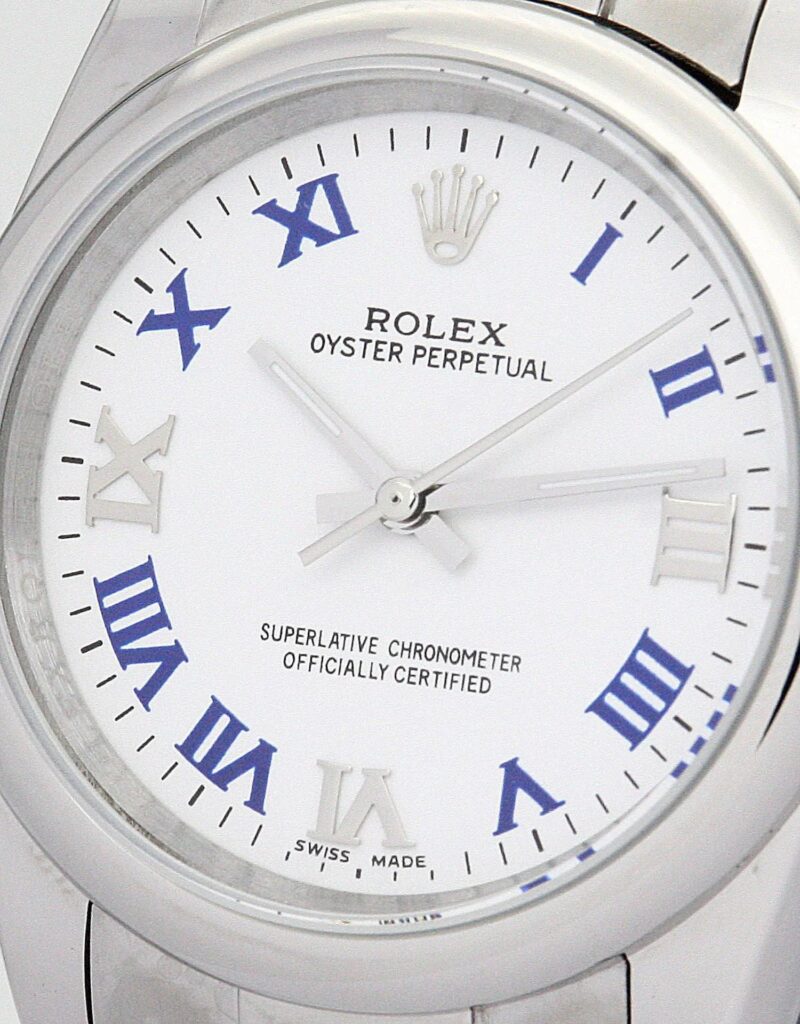
- Dial Details and Print Quality: The dial is the “face” of the watch, and counterfeiters consistently fail to replicate its precision. Inspect the print quality of the brand name, model name, numerals, and text (e.g., “Swiss Made,” water resistance ratings). Genuine watches use laser printing or enamel filling with crisp, sharp lettering, perfect kerning (letter spacing), and zero misspellings. Counterfeits often have blurry, smudged, or misspelled text (e.g., “Rolez” instead of “Rolex,” “Swis Made” instead of “Swiss Made”). The hour markers (stick, Arabic, or Roman) should be perfectly aligned with the hands and the dial’s center; counterfeit markers are often crooked, uneven, or the wrong size.
- Hand Alignment and Quality: The hour, minute, and seconds hands on a genuine luxury watch are perfectly aligned with the hour markers—at 12:00, the tips of the hands should point directly at the 12 o’clock marker with no overlap or gap. The hands are also made with high-quality metal, with a smooth, polished finish and no burrs or rough edges. Counterfeit hands are often misaligned, cheaply made, or the wrong shape (e.g., a Rolex Submariner’s seconds hand with a lollipop tip that is too large or too small).
- Logo and Emblem Placement: Brand logos (e.g., Rolex’s coronet, Omega’s omega symbol, Cartier’s double C) are perfectly positioned on the dial, crown, and clasp of genuine watches. The logo on the dial should be centered (or positioned according to the brand’s specific design) and symmetrical, with clean lines and no distortion. Counterfeit logos are often lopsided, the wrong size, or placed incorrectly (e.g., a Rolex coronet that is too high or too low on the dial).
At this stage, if you notice any obvious red flags—misaligned components, blurry print, or awkward proportions—you can immediately rule out the watch as genuine and walk away. For watches that pass the visual check, move on to the next, more detailed stage of authentication.
Step 2: Micro-Authentication – The Loupe Check (10x Magnification)
The micro-authentication stage is where most counterfeits—including mid-tier super clones—are exposed. Using a 10x loupe, you’ll inspect the tiny, precise details that luxury brands engineer to deter counterfeiters. These micro-markers are nearly impossible for scammers to replicate with mass-production methods, making them the gold standard for authentication.
Non-Negotiable Micro-Authentication Checks
- Serial and Reference Numbers: Every genuine luxury watch has a unique serial number (its “DNA”) and a reference number (which identifies the exact model). These numbers are engraved or laser-etched with razor-sharp precision on the watch’s case (between the lugs or on the rehaut, inner bezel ring).
- Location Check: Confirm the numbers are in the correct location for the brand and production year (e.g., Rolex post-2008: serial number on the rehaut at 6 o’clock; pre-2008: between the lugs at 6 o’clock). Counterfeits often have numbers in the wrong place or missing entirely.
- Quality Check: Genuine engravings are deep, crisp, and uniform in depth and width. The font matches the brand’s official font exactly. Counterfeit engravings are shallow, blurry, uneven, or filled with cheap paint to mimic depth (the paint will chip or peel with minimal wear).
- Consistency Check: The serial and reference numbers on the watch must match the numbers on the documentation (warranty card, service records). A mismatch is an immediate red flag for a counterfeit or stolen watch.
- Crystal and Micro-Engravings: Modern luxury watches feature micro-engravings on the sapphire crystal that are only visible with a loupe. These are some of the hardest details for counterfeiters to replicate.
- Rolex Micro-Coronet: All Rolex watches made from 2002 onward have a tiny coronet logo (0.1mm tall) etched at 6 o’clock on the crystal, perfectly positioned over the 6 o’clock marker. Counterfeits either omit this coronet, make it too large, or blur the edges.
- Omega Seamaster Wave Pattern: The Omega Seamaster’s ceramic bezel has a micro-engraved wave pattern with precise, uniform waves. Counterfeit bezels have blurry, uneven waves or gaps between the patterns.
- Crystal Quality: Genuine sapphire crystal is clear, scratch-resistant, and has a seamless anti-reflective (AR) coating on the inside (no bubbles or tint). Counterfeit crystals (often mineral glass or plastic) have a noticeable tint, bubbles in the AR coating, or are prone to scratches (even minor ones).
- Clasp and Bracelet Details: The clasp and bracelet are often overlooked by buyers, but they are rich with authentication markers.
- Engravings on Clasp: Genuine watch clasps have crisp engravings of the brand name, logo, and model (e.g., “Rolex Oyster Perpetual,” “Omega Co-Axial”). The font is consistent with the rest of the watch, and the engravings are deep and precise. Counterfeit clasps have blurry, shallow engravings or misspelled text.
- Bracelet Links: Genuine luxury watch bracelets use solid links (for metal bracelets) with precise machining and no gaps between links. The end-links (the links that attach to the lugs) are custom-made for each model and fit snugly against the case with no play. Counterfeit bracelets often use hollow links (making the watch feel lightweight), have gaps between links, or end-links that are ill-fitting and generic.
- Lume Quality and Application: Lume (the luminous material on the hands and hour markers) is another key micro-marker. Genuine luxury brands use high-quality lume (e.g., Rolex’s Chromalight, Omega’s Super-LumiNova) that is applied evenly, with no smudges or “spillover” onto the dial. The lume glows a specific color (e.g., deep blue for modern Rolex, green for Omega) and fades evenly over several hours. Counterfeit lume is applied unevenly, smudged, or glows the wrong color (e.g., green on a modern Rolex) and fades quickly or patchily.
Step 3: Material and Physical Authentication – Weight, Magnetism, and Measurements
Luxury watch brands use proprietary, high-density materials that counterfeiters cannot replicate at scale. Even top-tier super clones often cut corners on materials, leading to measurable differences in weight, magnetism, and dimensions. This stage of authentication uses the digital caliper, precision scale, and magnet test kit to verify the watch’s physical properties against the brand’s official specifications.
Key Material and Physical Checks
- Weight Verification: Use the precision scale to weigh the watch (including the bracelet) and compare the result to the brand’s official weight for that specific reference number. For example:
- Genuine Rolex Submariner 116610LN (40mm): ~155 grams
- Genuine Omega Seamaster Diver 300M (42mm): ~140 grams
- Dimension Measurement: Use the digital caliper to measure the watch’s case diameter, case thickness, and lug width. Compare these measurements to the brand’s official specs. Counterfeit watches often deviate by 0.5–1mm in diameter or thickness—differences that are too small to see with the naked eye but easy to detect with a caliper. For example, a genuine Rolex Datejust 41mm has a case diameter of exactly 41mm; a counterfeit may measure 40.5mm or 41.5mm.
- Magnetism Test: Most genuine luxury watch cases are made from non-magnetic materials: 904L/316L stainless steel, 18k gold, platinum, or titanium. Hold the neodymium magnet near the watch’s case (not the movement—keep the magnet at least 2 inches away from the dial to avoid magnetizing the movement). If the case is attracted to the magnet, it is made from a cheap magnetic alloy, confirming it’s a counterfeit. Note: Some watch components (e.g., the balance spring) are magnetic, so only test the case and bracelet, not the movement.
- Material Finish Test: Genuine luxury watch metals have a distinct, high-quality finish that resists smudges and corrosion. Rolex’s 904L Oystersteel, for example, has a bright, cold polish that does not tarnish with sweat or exposure to the elements. Counterfeit metals have a dull, cheap finish that smudges easily and may tarnish or discolor within weeks of wear. For gold watches, genuine 18k gold will not chip or fade, while plated counterfeits will show the base metal at the edges of the case or bracelet links with minimal wear.
Step 4: Mechanical Authentication – Testing the Movement and Functionality
The movement is the “heart” of a luxury watch, and it is the single hardest component for counterfeiters to replicate. Genuine luxury watch movements (mechanical, automatic, or quartz) are precision-engineered in Switzerland (or other reputable watchmaking hubs) to meet strict accuracy standards. Counterfeit movements are almost always cheap, mass-produced Chinese or Japanese movements that lack the precision, durability, and functionality of the real thing.
Mechanical Authentication for Automatic/Mechanical Watches
Most luxury watches on the secondary market are automatic or mechanical, so this is the most common mechanical check. Perform these tests to verify the movement’s authenticity:
- Seconds Hand Sweep Test: Observe the seconds hand under close inspection (a loupe helps). A genuine Swiss automatic movement has a perfectly smooth, continuous sweep around the dial—you cannot see individual steps, even with magnification. Counterfeit automatic movements (or quartz movements disguised as automatic) have a jerky seconds hand that jumps one second at a time, with a noticeable “tick” motion. Even the best cloned Swiss movements have a slight stutter in the sweep that is visible with a loupe.
- Winding and Power Reserve Test: Gently wind the watch’s crown (unscrew it first for screw-down crowns) and note the resistance. A genuine automatic movement has smooth, consistent resistance when winding—no grinding, stiffness, or looseness. The power reserve (the time the watch runs after being fully wound) should match the brand’s specifications (e.g., 48 hours for Rolex Cal. 3135, 60 hours for Omega Cal. 8800). Counterfeit movements have erratic winding resistance and a short power reserve (often less than 24 hours).
- Accuracy Test: If possible, test the watch’s accuracy over 24 hours using a timegrapher (a tool that measures a watch’s rate, amplitude, and beat error) or by comparing it to an atomic clock. Genuine Swiss luxury watches meet strict accuracy standards:
- Rolex Superlative Chronometer: -2/+2 seconds per day
- Omega Master Chronometer: 0/+5 seconds per day
- Functionality of Complications: For watches with complications (date, day, chronograph, GMT, perpetual calendar), test every function to ensure it works smoothly and accurately.
- Date Window: The date should change instantly at midnight (or within 1–2 minutes) on a genuine watch, with no partial numbers or lag. Counterfeit date windows often change slowly (taking 5–10 minutes) or get stuck on partial numbers.
- Chronograph: The chronograph pushers on a genuine watch click firmly with no play, and the chronograph hands start, stop, and reset to zero perfectly. Counterfeit pushers are loose or sticky, and the chronograph hands may not reset to zero or may stick during use.
- GMT Function: The GMT hand on a genuine watch aligns perfectly with the bezel’s numerals and moves smoothly when adjusted. Counterfeit GMT hands are often misaligned or stiff to move.
Mechanical Authentication for Quartz Watches
While quartz luxury watches are less common, they still require mechanical authentication. Key checks include:
- Silence Test: Genuine Swiss quartz movements are nearly silent—you will hear no “tick” sound when holding the watch to your ear. Counterfeit quartz movements are loud, with a distinct, rattling tick sound.
- Accuracy Test: Genuine quartz watches are ultra-accurate, losing or gaining less than 15 seconds per month. Counterfeit quartz watches lose or gain minutes (or even hours) per week.
- Battery Compartment (Case Back Models): For quartz watches with a snap-off case back, the battery compartment should have a genuine brand battery (e.g., Renata for Swiss watches) and a secure battery clip. Counterfeit watches use cheap, generic batteries and flimsy clips that are prone to breaking.
Step 5: Documentation and Packaging Authentication – The Final Verification
Even if a watch passes all physical and mechanical checks, it is not genuine unless it comes with authentic documentation and packaging. Luxury brands invest heavily in the security and quality of their paperwork and boxes, and counterfeiters simply cannot replicate these details. This is the final, critical step in the authentication process—one that many buyers overlook, leading to costly mistakes.
Key Documentation Checks
The most important document for any luxury watch is the warranty card (also called a guarantee card). For pre-owned watches, service records are also crucial. Perform these checks to verify documentation authenticity:
- Warranty Card Security Features: Modern luxury watch warranty cards have advanced security features that counterfeiters cannot forge, including:
- Holographic Stickers: A 3D hologram with the brand’s logo that changes appearance when tilted (e.g., Rolex’s hologram on post-2010 warranty cards).
- Microprinting: Tiny text (only visible with a loupe) that reads the brand name or model number—counterfeit cards have blurry microprinting or no microprinting at all.
- NFC/QR Codes: Many modern brands (e.g., Omega, Cartier) include an NFC chip or QR code that links to the brand’s official database, where you can verify the watch’s serial number and purchase details.
- UV-Reactive Ink: Under a 365nm UV flashlight, genuine warranty cards have hidden text or logos that glow—counterfeit cards have no UV-reactive features.
- Information Consistency: The information on the warranty card must match the watch exactly:
- Serial number = serial number on the watch
- Reference number = reference number on the watch
- Purchase date = consistent with the watch’s production year (e.g., a watch produced in 2020 cannot have a purchase date of 2015)
- Dealer stamp = a genuine authorized dealer stamp (verify the dealer’s name and location on the brand’s official website)
- Service Records (Pre-Owned Watches): For pre-owned watches, genuine service records from an authorized brand service center include:
- The watch’s serial and reference numbers
- A detailed list of work performed (e.g., gasket replacement, movement lubrication)
- The date of service and the authorized dealer’s stamp
- Genuine replacement part numbers (if applicable)
Key Packaging Checks
Luxury watch packaging is designed to protect the watch and reflect the brand’s prestige. Counterfeit packaging is cheap, flimsy, and lacks the attention to detail of the real thing:
- Box Quality: Genuine luxury watch boxes are made from high-quality materials (e.g., leather, wood, rigid cardboard) with a smooth, premium finish. The brand’s logo is embossed or engraved (not printed) on the outside, with crisp, sharp lettering. Counterfeit boxes are made from cheap cardboard or plastic, with a blurry printed logo and a flimsy construction.
- Interior Fit: The interior of the genuine box is lined with soft velvet, suede, or foam that is custom-molded to fit the watch perfectly—no gaps, no movement when the box is closed. Counterfeit box interiors are generic, with a loose-fitting cushion that allows the watch to slide around.
- Accessories: Genuine luxury watches come with brand-specific accessories, including:
- A high-quality dust bag with the brand’s logo
- An instruction manual (customized for the specific model, with crisp, colorful pages)
- A warranty card holder (matching the box’s material)
- Model-specific tools (e.g., a link removal tool for Rolex bracelets, a screwdriver for Omega Seamaster straps)
Brand-Specific Authentication Shortcuts – For the Most Counterfeited Models
While the universal authentication steps work for all luxury watches, the most counterfeited brands (Rolex, Omega, Cartier) have unique markers that allow for quick, targeted checks. Memorize these shortcuts to authenticate these iconic models in minutes:
Rolex Authentication Shortcuts
- Rehaut Engravings: Post-2005 Rolex models have a repeating “ROLEX” engraving around the rehaut, laser-etched with perfect spacing and sharpness. Counterfeits have thick, wobbly engravings or no rehaut engravings at all.
- 2.5x Cyclops Magnification: The Cyclops lens over the date window magnifies the date exactly 2.5x, with no distortion. Counterfeits have 2x magnification or a misaligned lens that distorts the date.
- Triplock/Twinlock Crown: Rolex’s crown has 3 (Triplock) or 2 (Twinlock) rubber gaskets for water resistance. When screwed down, it clicks firmly and sits flush with the case. Counterfeit crowns have no gaskets, are loose when screwed down, or do not click.
Omega Authentication Shortcuts
- Co-Axial Escapement: Modern Omega watches with the Co-Axial movement have “Co-Axial” engraved on the dial or case back. The escapement (visible on open-case-back models) has a unique design that counterfeiters cannot replicate.
- Helium Escape Valve (Seamaster): The Omega Seamaster’s helium escape valve is functional and has the Omega logo engraved on it. Counterfeit valves are fake—they do not open or close—and have a blurry logo.
- Master Chronometer Certification: Omega Master Chronometer models come with a certification card that can be verified on the Omega official website using a unique QR code. Counterfeit certification cards have invalid QR codes or no certification at all.
Cartier Authentication Shortcuts
- Sapphire Cabochon Crown: All genuine Cartier watches have a deep blue sapphire cabochon on the crown, cut perfectly and set securely with no gaps. Counterfeit cabochons are made of cheap glass or plastic, with a pale blue color and loose setting.
- Roman Numeral “VII”: Cartier’s dial features a full “VII” numeral (not a “VI” with a line or a lopsided symbol). Counterfeits often get this detail wrong, using a non-standard “VII”.
- Santos Screws: The Cartier Santos has exposed hexagonal screws on the case that are perfectly aligned and made of the same metal as the case. Counterfeit screws are misaligned, have a blurry hexagonal head, or are plated metal that chips easily.
When to Call in the Experts – Professional Authentication
The authentication steps outlined in this guide will help you spot 99% of counterfeit luxury watches, including most super clones. However, for high-value watches (>$10,000), vintage watches (pre-1990), or watches with no documentation, it is always wise to seek professional authentication for 100% certainty.
Professional horologists at authorized brand service centers or reputable independent authentication services have access to tools and resources that the average buyer does not, including:
- Brand-specific databases of serial and reference numbers
- X-ray and microscopy equipment to inspect internal movement parts
- Expert knowledge of vintage watch variations and rare models
Reputable professional authentication services include:
- Authorized Brand Service Centers: The gold standard—Rolex Service Centers, Omega Service Centers, etc. They provide a written authentication report and warranty for their work.
- AWCI-Certified Horologists: Independent watchmakers certified by the American Watchmakers-Clockmakers Institute, with expertise in authenticating all luxury brands.
- Specialized Authentication Services: Companies like the Watch Authentication Company (WAC) and AuthenticWatches.com, which focus solely on luxury watch authentication and provide a detailed written report.
Professional authentication typically costs $150–$300, a small investment compared to the cost of a counterfeit watch. The written report also adds value to the watch, as it serves as proof of authenticity for insurance and resale.
Final Checklist – Authenticate a Luxury Watch in 10 Minutes
To make the authentication process easy to remember, use this 10-minute checklist before any luxury watch purchase:
- Seller Check: Verify reputation, transparency, and return policy.
- Visual Check: Inspect proportion, finish, dial print, and hand alignment.
- Loupe Check: Examine serial/reference numbers, crystal micro-engravings, clasp engravings, and lume.
- Physical Check: Weigh the watch, measure dimensions, and test for magnetism.
- Mechanical Check: Test seconds hand sweep, winding resistance, and complication functionality.
- Documentation Check: Verify warranty card security features and information consistency with the watch.
- Packaging Check: Inspect box quality, interior fit, and included accessories.
Conclusion: Authenticity Is the Foundation of Luxury Watch Collecting
Authenticating a luxury watch before you buy is not just a precaution—it is the foundation of responsible collecting and investing. In a market flooded with increasingly sophisticated counterfeits, the ability to distinguish a genuine timepiece from a fake is a skill that every buyer, from novice to expert, must master.
Remember: genuine luxury watches are built with uncompromising attention to detail—details that counterfeiters, no matter how advanced their technology, cannot replicate. A genuine watch will feel substantial in your hand, run smoothly and accurately, and feature crisp, precise engravings and documentation. A counterfeit watch will always have at least one flaw—whether a blurry micro-engraving, a jerky seconds hand, or a mismatched warranty card—that a systematic authentication process will uncover.
By following the steps outlined in this guide—conducting seller due diligence, performing visual, micro, physical, and mechanical checks, and verifying documentation and packaging—you can buy luxury watches with confidence, knowing that you are investing in a genuine piece of horological craftsmanship. And when in doubt, never hesitate to call in the experts: professional authentication provides priceless peace of mind and ensures that your dream watch is exactly what it claims to be.
Luxury watch collecting is a passion built on authenticity, craftsmanship, and legacy. With these authentication skills, you’ll protect that passion, avoid costly mistakes, and build a collection of timepieces that you can enjoy for a lifetime—and pass down to future generations with pride.
Leave a Reply