
The movement – often described as the core of a luxury mechanical watch – remains the most defining feature separating authentic Rolex pieces from even the most accomplished replicas or super-clones. For collectors, purchasers, and sellers alike, a precise understanding of movement details is essential for making wise decisions, safeguarding investments, and appreciating the tradition and engineering that signify Rolex’s unmatched reputation. This comprehensive guide delivers practical expertise, technical distinctions, concrete authentication steps, and vital considerations for buyers and sellers across the UK and US markets.
This guide is presented for informational purposes. Bob’s Time Watches is not affiliated with Rolex S.A., Rolex USA, or any of their subsidiaries. All mentions of Rolex and related models are for the purpose of illustrating pre-owned, replica, or Super Clone Watches, with no brands sponsoring our content.
Introduction to Rolex Movements
What Makes Rolex Movements Unique
Rolex is a benchmark of luxury mechanical watches, recognized for its obsession with precision engineering and durability. Every movement, or “caliber,” built by the company is the result of decades of innovation and rigorous testing. These mechanisms embody Swiss precision, not only in timekeeping accuracy but also through their structural and aesthetic refinement.
Defining attributes of authentic Rolex movements include:
- Swiss Precision: Individually handcrafted in Switzerland, Rolex movements employ proprietary alloys like nickel-phosphorus. The use of the Parachrom hairspring gives heightened resistance to magnetic fields and shocks.
- Decorative Finishing: Expect gleaming, mirror-polished surfaces alongside Geneva stripes, expertly beveled edges, and meticulously set synthetic ruby jewels.
- COSC Certification: Every mechanical movement is tested by the Official Swiss Chronometer Testing Institute and achieves “Superlative Chronometer Officially Certified” status, confirming a tolerance usually within -2/+2 seconds per day.
- Rotor Construction: The bi-directional Perpetual rotor guarantees seamless self-winding and delivers a smooth, efficient energy transfer to the mainspring.
- Complication Integration: Date switching at midnight, precisely operating GMT and chronograph features, and instantaneous adjustment characterize advanced Rolex calibers.
- Housing and Materials: Oystersteel casebacks ensure structural integrity and water resistance, even for deep diving or sporting usage.
These factors also account for the technical challenges replica makers face, especially when attempting to emulate the detail seen in authentic movements. This is most apparent in super-clones watches, which approach the real thing in outward appearance but typically miss the subtler engineering and finishing hallmarks.
Evolution of Rolex Calibers – Key Milestones
Rolex’s innovation trajectory is mapped through its evolving calibers. Collectors and enthusiasts respect these iterations, not just for mechanical breakthroughs but also for their impact on authenticity verification.
- Early Manual Calibers: The 700 series, developed during the mid-20th century, set reliability and serviceability standards for future Rolex movements.
- Perpetual Automatics: With the debut of calibers like the 3135, the Datejust and Submariner lines became synonymous with accurate, dependable timekeeping.
- Modern Breakthroughs: The Caliber 3235, a recent flagship movement, features a 70-hour power reserve, the advanced Chronergy escapement, and a Parachrom hairspring – delivering superior reliability. The popular Bob’s Time Rolex Submariner model with Caliber 3235 encapsulates this new technical peak.
- Function-Specific Movements: Models such as the Daytona integrate high-frequency chronographs, while GMT-Master II uses specially designed dual-time mechanisms.
You can explore the rich landscape of both genuine and high-quality replicas within our detailed automatic replica Rolex collections, featuring a spectrum spanning traditional and contemporary calibers.
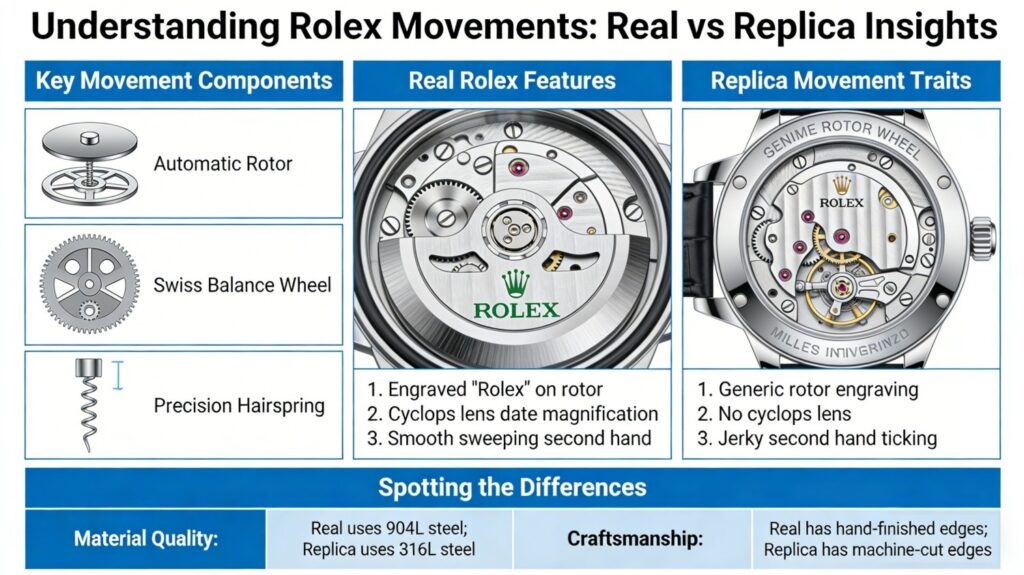
Visual and Technical Differences: Real vs Replica Rolex Movements
With advancements in the replica market, notably the rise of super-clones, basic external checks are no longer enough. Accurate authentication involves inspecting internal features – some visible only to a trained eye or through professional tools.
Finishing and Engravings
Genuine Rolex movements are distinguished by:
- Engravings: Deeply stamped and crisply executed “Rolex” scripts and caliber identifiers, visible on bridges and rotors.
- Decorative Techniques: High-polish finishes, Geneva stripes, and mirror edges are applied with consistency; no surface appears rushed or unfinished.
- Jewel Setting: Synthetic rubies are precisely aligned and set evenly, blending functionality with visual symmetry.
- Absence of Tool Marks: Polished bridges and plates are completely free from burrs or machining streaks.
Contrastingly, super-clone and other replica movements, regardless of outward appearance, frequently have:
- Shallow or Uneven Scripts: Laser or template engraving may appear faint or inconsistent, and logos can seem blurry at high magnification.
- Unfinished Plates: Surfaces often appear grainy, brushed without consistency, or reveal visible factory tool marks.
- Imprecise Jewel Placement: Misaligned or off-color jewels; sometimes appearing deadened or lacking luster.
- Varying Edge Finish: No clear or sharp bevel, and softer, less defined join lines.
Rotor and Jewels Inspection
The oscillating weight – called the rotor – provides several clues:
- Authentic Rotor: Deep, clear engraving; a flawlessly centered Rolex coronet; high-quality polish or unique finishing touches, sometimes with gold or two-tone effects.
- Red Reversing Wheels: Found on many classic calibers, their consistent color and fit are nearly impossible for most replicas to emulate precisely.
- Replica Rotor: Off-center logos, surface scratches, dull finishes, and missing or inaccurate red wheels are common.
Jewels function as both mechanical and decorative highlights. Authentic Rolex placements are uniform, while replicas may show irregularity in number, size, position, or color.
Functionality Tests
Hands-on examination underscores the movement’s true quality:
- Genuine Seconds Hand: Glides nearly seamlessly due to the high-frequency beat of mechanical Rolex movements.
- Replication Issues: Even premier super-clones may stutter, hesitate, or subtly tick.
- Complications: The date flicks precisely at midnight and chronograph or GMT functions operate without lag or sticking on authentic models, which replicas often struggle to replicate.
- Audible Differences: Rolex rotors operate quietly. Excess mechanical noise points to less sophisticated assembly found in replicas.
Comparison Table: Genuine vs Replica Rolex Movements
| Feature | Genuine Rolex Movement | Replica Movement Red Flags |
|---|---|---|
| Finishing | Polished plates, Geneva stripes, flawless edges | Grainy surfaces, unfinished or rough edges |
| Engravings | Deep, crisp, perfectly aligned | Shallow, uneven, blurry or laser-etched |
| Rotor | Centered coronet, sharp detail, smooth finish | Off-center, faded logo, poor surface quality |
| Red reversing wheels | Present in applicable models, precise tone | Absent, mismatched hue, or inaccurate assembly |
| Jewel placement | Uniform color, position, and brilliance | Dull, misaligned, color variation |
| Seconds hand | Smooth, fluid sweep | Erratic or ticking motion |
| Complications | Accurate, instant function | Delayed or misaligned changes |
If you are interested in examining some of the finest super-clone offerings, you may shop high-quality Super Clone Watches, where faithful reproduction meets the limitations of non-genuine craftsmanship.
Step-by-Step Authentication Guide for Rolex Movements
Identifying real from replica Rolex movements is a multistage process, best performed with care and knowledge. While many red flags are apparent to seasoned collectors, the risks of damaging vital watch components or undermining water resistance mean case opening should be entrusted to professionals wherever possible.
How to Access the Movement
- Only a qualified watchmaker should open a Rolex case. Unskilled attempts frequently break seals, damage O-rings, or mar the case back and lugs.
- Use proper caseback removal tools; avoid prying or makeshift attempts that can destroy value.
- Once open, avoid home water-resistance tests. Reassembly should always include professional pressure testing.
Checklist of Key Red Flags in Replica Movements
Inspect for these signs (using a loupe or microscope where possible):
- Unfinished movement plates: roughness, visible tool marks, or incomplete polish.
- Engravings that are faint, off-center, or lack relief depth.
- Incorrect, missing, or poorly duplicated model numbers and branding scripts.
- Jewels that appear dull, uneven, or wrongly colored.
- Rotor engravings that are faded, off-centre, or lack surface quality.
- Ticking or interrupted seconds hand movement in mechanical models.
- Resistance or inaccuracy in setting complications, such as lagging date functions.
- Presence of transparent case backs on modern watches (rare in authentic post-vintage Rolex).
- Non-matched or inconsistently formatted serial numbers on movement and case.
- Mismatched caliber numbers for the stated model.
Authentication Steps:
- Confirm the watch’s paper trail, service history, and receipts from trusted dealers.
- Compare all visible serial numbers on movement, case, and rehaut against original documentation.
- Use magnification to review engraving quality, alignment, and micro-etchings.
- Operate every complication to assess performance and alignment.
- Review for features inconsistent with the manufacturing era – such as modern rehaut engravings on vintage-styled cases.
Testing Movement Features for Authenticity
- Wind the watch and observe for resistance and feedback: authentic winding should feel refined, not gritty or uneven.
- Set date and time, noting alignment and sharpness of the “jump” or changeover.
- Listen: excessive rotor noise, grinding, or rattling suggests replica or poor assembly.
For further detail on authentication steps and practical detection, see Bob’s Time’s expert guides on spotting fake Rolex and super clones.
Understanding Rolex Serial Numbers and Supporting Authentication Checks
Serial numbers remain a powerful tool in the authentication arsenal, but their interpretation demands attention to manufacturing period and placement.
Serial Number Placement Evolution
- Pre-2005: Serial numbers engraved between the lugs at the 6 o’clock position, visible only after bracelet removal.
- 2005–2010: Both the case lug and the inside rehaut (inner bezel) show the serial, the latter with elaborate “ROLEX ROLEX” engraving around the dial’s edge.
- 2010 to present: Serial numbers became randomized and are only found on the rehaut, improving forgery resistance.
Timeline Summary:
- Until 2005: 6 o’clock case lug.
- 2005–2010: Case lug plus inner rehaut, “ROLEX” engraved.
- 2010-plus: Inner rehaut only, random alphanumeric sequence.
Matching Serial Numbers with Movement and Case
- All serials and reference numbers on the watch must match those on the original sales and service papers.
- Mismatches (e.g., different numbers on movement and case) point toward unauthorized repair, movement swapping, or outright forgery.
- Swapped movements are often encountered on watches that have been serviced by non-authorized repairers or after significant damage.
Additional Features: Crystal Micro-etching and Case Back Details
- Coronet Micro-Etching: From 2002 onward, genuine Rolex models feature a near-invisible micro-coronet logo at 6 o’clock on the crystal, visible under 10x magnification. Its position, clarity, and execution are extremely difficult for counterfeiters to imitate exactly.
- Case Backs: Modern Rolex watches (except certain rare editions) have solid steel case backs, unadorned except for minimal factory marks.
- Rehaut Engraving: “ROLEX ROLEX” and a precise serial at 6 o’clock on the inner ring aids in post-2005 authentication.
Bullet-Point Facts for Quick Checks:
- Authentic engravings are sharp, deep, and symmetrically aligned.
- Missing or inconsistently engraved serials or “ROLEX” on a modern watch should raise alarms.
- The crystal coronet is always directly at 6 o’clock and expertly executed – test with magnification.
- Serial mismatch or visible alteration around lugs or rehaut is a strong red flag.
Professional Verification and Additional Tips
Given today’s high-quality replicas and super-clones, even a detailed examination by a knowledgeable owner may fall short. When substantial investment, insurance, or resale is at stake, specialist authentication is the prudent choice.
Benefits of Professional Authentication
- Specialist Tools: Watchmakers can dismantle the movement, use high-magnification optics, and deploy UV or X-ray tools that expose micro-structural or invisible discrepancies.
- Water Resistance Restoration: Only professional reassembly ensures continued water-tightness and maintains the manufacturer’s standard.
- Comprehensive Reports: Authentication often includes photos, timekeeping checks, official letterhead, and documentation suitable for insurance and resale.
Typical Costs and Services Available
- Standard fees for professional authentication start from £80–£120 (UK) or $100–$150 (US), with added costs for certificate documentation or valuation for insurance.
- Many professional shops also offer maintenance, cleaning, mechanical service, and value estimation alongside authentication.
Limitations of DIY Movement Authentication
- Opening Rolex cases without training risks irreversible physical and value damage.
- Super-clone replicas are built to pass most casual checks; nuanced flaws are often visible only to seasoned experts using advanced equipment.
- Swapped, refurbished, or damaged parts can obscure tell-tale authenticity details.
For these reasons, it is advisable to leave complex assessments to professionals or certified appraisers whenever possible.
Common Myths and Pitfalls to Avoid
- “A sweeping seconds hand always proves authenticity.” Many replicas use hybrid movements to mimic this hallmark, deceiving unwary owners.
- “Modern Rolex watches have see-through case backs.” Only select exhibition or custom models diverge; most have solid steel rear covers.
- “Papers guarantee genuineness.” Faked or mismatched paperwork is common; all physical and documentary evidence must be consistent.
- “Super-clones cannot be identified.” Under magnification, even the best counterfeits reveal flaws in engraving, jewel setting, or component finish.
- “Serial number presence means authentic.” Counterfeiters duplicate serials widely. Only correlation with authenticity records offers reliability.
Those aiming to sell your Replica or SUPER-CLONE Rolex watch securely benefit from documentation, professional authentication, and secure processes to maximize return and confidence.
Frequently Asked Questions About Rolex Movement Authentication
- Can you tell a real Rolex movement without opening the case?
In some cases, external clues (weight, seconds hand action, and dial markers) suggest authenticity, but definitive checks require internal examination. - Are all Rolex movements mechanical?
Nearly all Rolex movements are mechanical – automatic or hand-wound – with the rare exception of Oysterquartz models, which are dated and uncommon. - What does rehaut engraving indicate?
“ROLEX ROLEX” on the inner bezel was introduced from 2005 onwards and serves as an anti-counterfeiting device. Quality, placement, and inclusion of a serial number at 6 o’clock provide authenticity markers. - Can super clones fool movement checks?
High-end super clones are built to imitate, but they typically fall short at the micro-level. Discrepancies in finishing, functionality, and marking precision eventually betray even the finest counterfeits. - How to interpret mismatched serial numbers?
Conflicts between case, movement, and paperwork numbers indicate a replaced movement, repair with non-original parts, or a fake. Always seek full alignment across all identifiers. - Cost of professional authentication?
In the UK, authentication typically costs £80–£120, while similar services in the US average $100–$150. Certificates or full written reports may increase these costs. - Role of the Cyclops lens over date windows?
The Cyclops is a 2.5x magnifying lens placed directly above the date. Authorized Rolex watches feature precise alignment and distortion-free magnification; askew or weak magnification often suggests a replica. - Is a clear case back ever correct for a modern Rolex?
No, apart from specific exhibition or vintage pieces, a transparent back generally signals a non-authentic or modified piece. - Does the movement number always match the model reference?
Yes, each Rolex model aligns with exact caliber specifications. Any mismatch signifies a replacement or counterfeit movement. - Are UV or X-ray tests needed for verification?
Professional appraisers may use UV light or X-ray analysis on advanced super-clones or when standard checks are inconclusive.
This article is intended for educational use and does not replace professional appraisal, insurance advice, or legal guidance. Brand references are purely descriptive; Rolex and relevant trademarks belong to their respective owners. For legally binding authentication and risk management, consult a certified horological expert.
Those wishing to explore, purchase, or resell authentic and high-quality replica Rolex models – including pre-owned and super-clone options – will find peace of mind through Bob’s Time Watches‘s curated selection, warranty-backed services, and professional community dedicated to excellence in horology.
Leave a Reply