
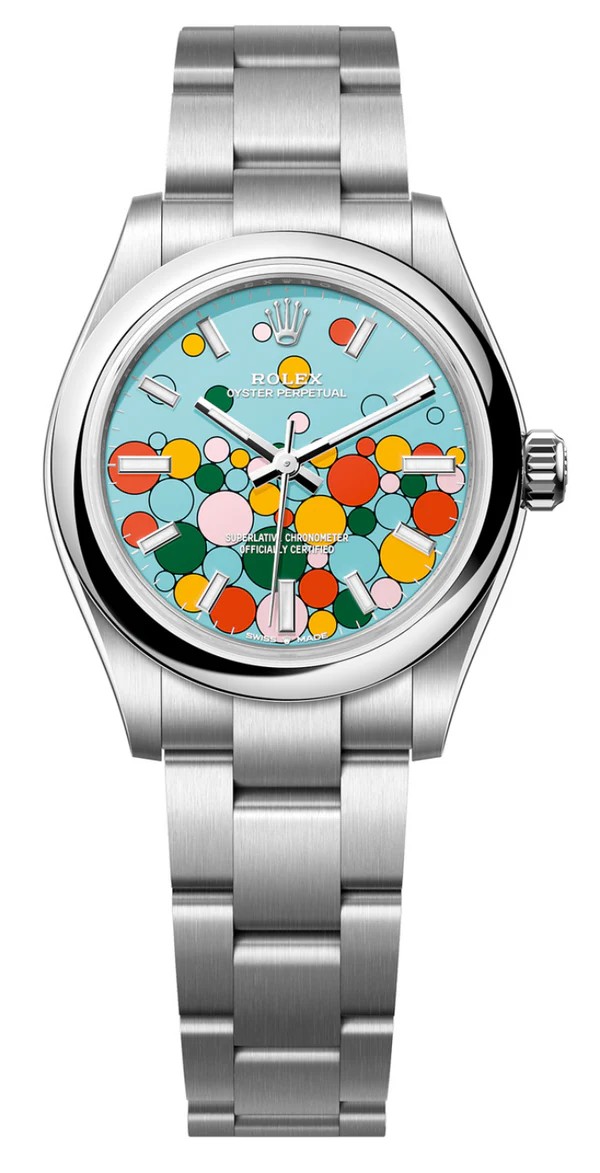
In the pantheon of horology, few names resonate with the same level of prestige, innovation, and timeless appeal as Rolex. Among its illustrious catalog, the Rolex Oyster Perpetual stands as the foundational pillar upon which the entire brand was built. It is not merely a watch; it is the archetype of the modern wristwatch, representing the convergence of two revolutionary technologies: the waterproof Oyster case and the self-winding Perpetual movement.
For collectors, enthusiasts, and investors alike, understanding the history and evolution of the Rolex Oyster Perpetual is essential. It is a journey through a century of engineering breakthroughs, design refinements, and cultural shifts. From the dusty workshops of Hans Wilsdorf in the 1920s to the sleek, colorful iterations of today, the Rolex Oyster Perpetual has remained true to its core identity while adapting to the changing tides of time. This comprehensive guide delves deep into the lineage of this icon, exploring its key milestones, reference numbers, and the nuances that make certain vintage models highly coveted treasures in the modern market.
The Genesis: Two Revolutions in One Case
To understand the Oyster Perpetual, one must first dissect its name, for each word represents a monumental leap forward in watchmaking history.
The Oyster Case: Defying the Elements
Prior to 1926, wristwatches were fragile instruments, highly susceptible to dust and moisture. Pocket watches were still preferred by many for their reliability. Hans Wilsdorf, the visionary founder of Rolex, sought to change this perception. He envisioned a wristwatch that could withstand the rigors of daily life, water, and dust. The result was the Rolex Oyster Perpetual, patented in 1926.
The Oyster case featured a hermetically sealed design with a screw-down crown, case back, and bezel. This innovation was not just theoretical; it was proven in dramatic fashion in 1927 when Mercedes Gleitze swam the English Channel wearing a Rolex Oyster. After more than ten hours in the icy water, the watch emerged still ticking perfectly. This event catapulted Rolex into the global spotlight and established the Oyster case as the gold standard for durability.
The Perpetual Movement: Harnessing Motion
While the Oyster case solved the problem of protection, the power source remained a hurdle. Early wristwatches required manual winding, a tedious task that, if forgotten, would stop the watch. In 1931, Rolex introduced the Perpetual rotor mechanism. This ingenious self-winding system utilized a semi-circular weight that swung freely with the motion of the wearer’s wrist, transferring energy to the mainspring.
Unlike previous attempts at self-winding mechanisms that often wound in only one direction or were prone to breaking, the Rolex Perpetual rotor was efficient, robust, and bidirectional. It meant that as long as the watch was worn, it would remain wound. The combination of the Oyster case and the Perpetual movement created a watch that was both rugged and convenient—a “set it and forget it” instrument that was unprecedented in the industry.
The Birth of the “Oyster Perpetual” Name
Although the technologies existed separately in the late 1920s and early 1930s, it wasn’t until the late 1930s and early 1940s that Rolex began branding watches explicitly as the “Oyster Perpetual.” Initially, these terms appeared on dials separately or in conjunction with other model names (like the Bubbleback). The Bubbleback, produced from the 1930s to the 1950s, was arguably the first mass-produced self-winding waterproof watch and served as the direct ancestor to the modern Oyster Perpetual line.
Post-World War II, as Rolex refined its manufacturing and consolidated its lineup, the “Oyster Perpetual” designation became the umbrella term for their core collection of time-only (hours, minutes, seconds) watches. These were the purest expressions of the brand’s philosophy: no date, no day, no chronograph complications—just precise timekeeping in an indestructible package.
The Golden Era: 1950s to 1970s
The mid-20th century marked the golden age of the Oyster Perpetual. As the global economy boomed, so did the demand for reliable luxury goods. Rolex responded with a series of references that have since become legendary among collectors.
Reference 1002 and 1003: The Entry-Level Legends
Introduced in the late 1950s, the Reference 1002 (smooth bezel) and Reference 1003 (fluted bezel) defined the aesthetic of the era. With case sizes around 34mm—considered generous for the time but modest by today’s standards—these watches featured clean dials, applied hour markers, and the iconic cyclops lens was notably absent, preserving the symmetry of the dial.
These models were available in stainless steel, yellow gold, and Rolesor (Rolex’s combination of steel and gold). They were powered by the robust Caliber 1560 and later the Caliber 1570, movements renowned for their accuracy and ease of service. For many collectors, a vintage Ref. 1002 or 1003 in original condition represents the quintessential vintage Rolex experience. Their understated elegance makes them versatile enough for a tuxedo or a t-shirt, embodying the concept of “quiet luxury” long before the term existed.
The Transition to 36mm: Reference 1500 Series
As tastes shifted towards larger watches in the 1970s, Rolex introduced the Reference 1500 series. This was a significant evolution, moving the standard case size to 36mm, which would remain the standard for men’s Oyster Perpetuals for decades. The Ref. 1500 retained the classic design language but incorporated updated movements like the Caliber 1570 with a hacking seconds function (allowing the watch to be stopped precisely for setting).
This era also saw the introduction of various dial textures, including linen, honeycomb, and stone dials, adding a layer of collectibility. The “Stella” dials—lacquered in vibrant colors like red, blue, and green—are particularly rare and command high premiums at auction, showcasing Rolex’s willingness to experiment with aesthetics even within their most conservative line.
The Modern Era: Refinement and Standardization (1980s–2010s)
Entering the 1980s and 1990s, Rolex focused on refining materials, improving movement precision, and standardizing their collections. The Oyster Perpetual line saw the introduction of the Reference 14200 and later the 114200.
Sapphire Crystals and Solid End Links
A major technical upgrade during this period was the switch from acrylic crystals to scratch-resistant sapphire crystals. This significantly improved durability and clarity. Additionally, the bracelets evolved from hollow end links to solid end links (SEL), giving the watches a more substantial feel and a tighter fit on the wrist.
The 114200 and 114300: The Workhorses
The Reference 114200 (produced roughly from 2000 to 2014) and its successor, the 114300, became the definitive modern Oyster Perpetuals. Featuring the 31mm and 36mm case sizes respectively, these watches housed the Caliber 3130 movement, a COSC-certified chronometer known for its reliability and longevity. The design remained faithful to the original ethos: domed bezels, simple baton or numeral markers, and a focus on legibility.
During this period, the Oyster Perpetual solidified its reputation as the ultimate “beater” luxury watch—a timepiece that could be worn daily, beaten up, serviced easily, and still retain significant value. It became the gateway drug for many entering the world of Rolex collecting, offering the full Rolex experience without the complexity or cost of a Submariner or Daytona.
The Renaissance: 2020 and Beyond
In 2020, Rolex executed one of the most successful product launches in its recent history, completely revitalizing the Oyster Perpetual line. The brand discontinued the previous references and introduced a new generation featuring a slightly redesigned case with sharper lugs and, most controversially and successfully, a range of vibrant dial colors.
The Color Explosion
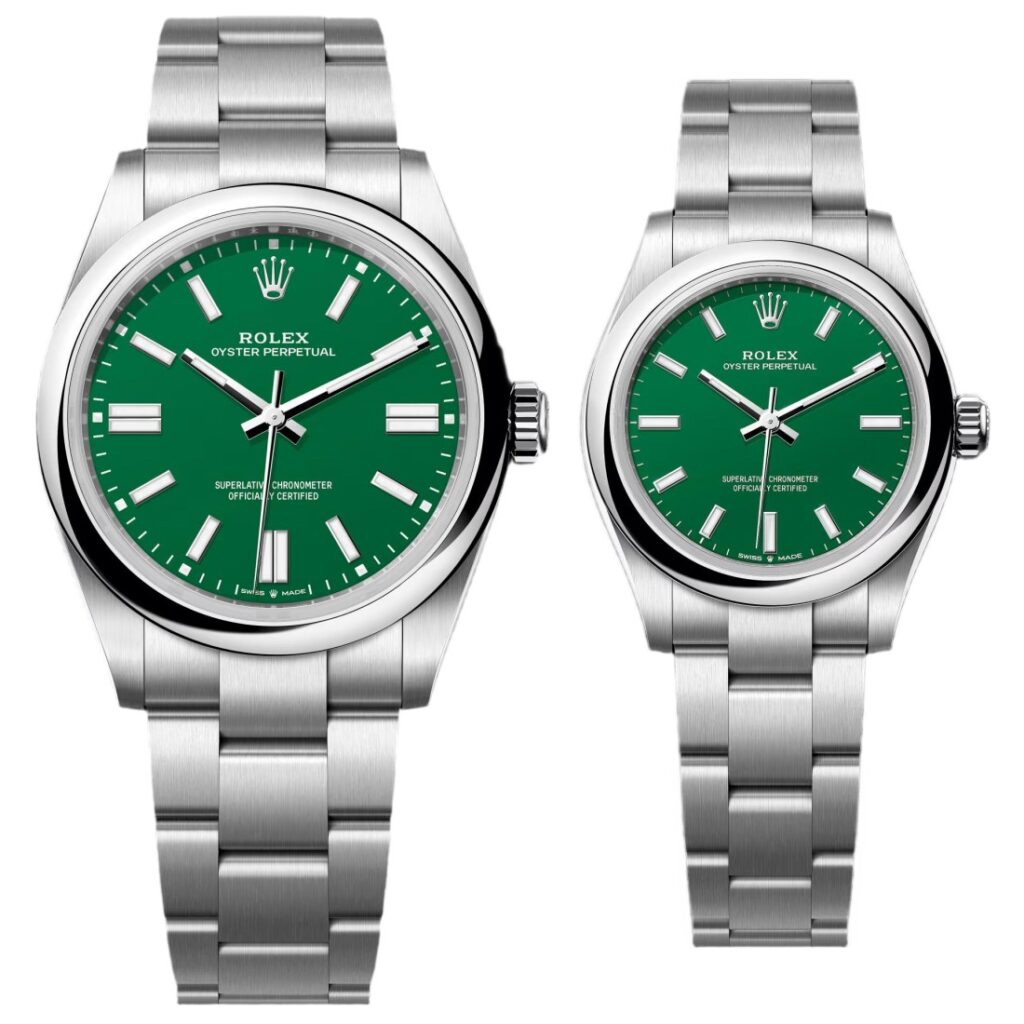
Gone were the subdued silvers and champagnes of the past. The new lineup featured dials in Turquoise Blue, Coral Red, Yellow, Green, and Candy Pink. This bold move transformed the Oyster Perpetual from a conservative dress watch into a statement piece. The “Stella” spirit of the 1970s had returned, but this time, it was accessible across the entire production run.
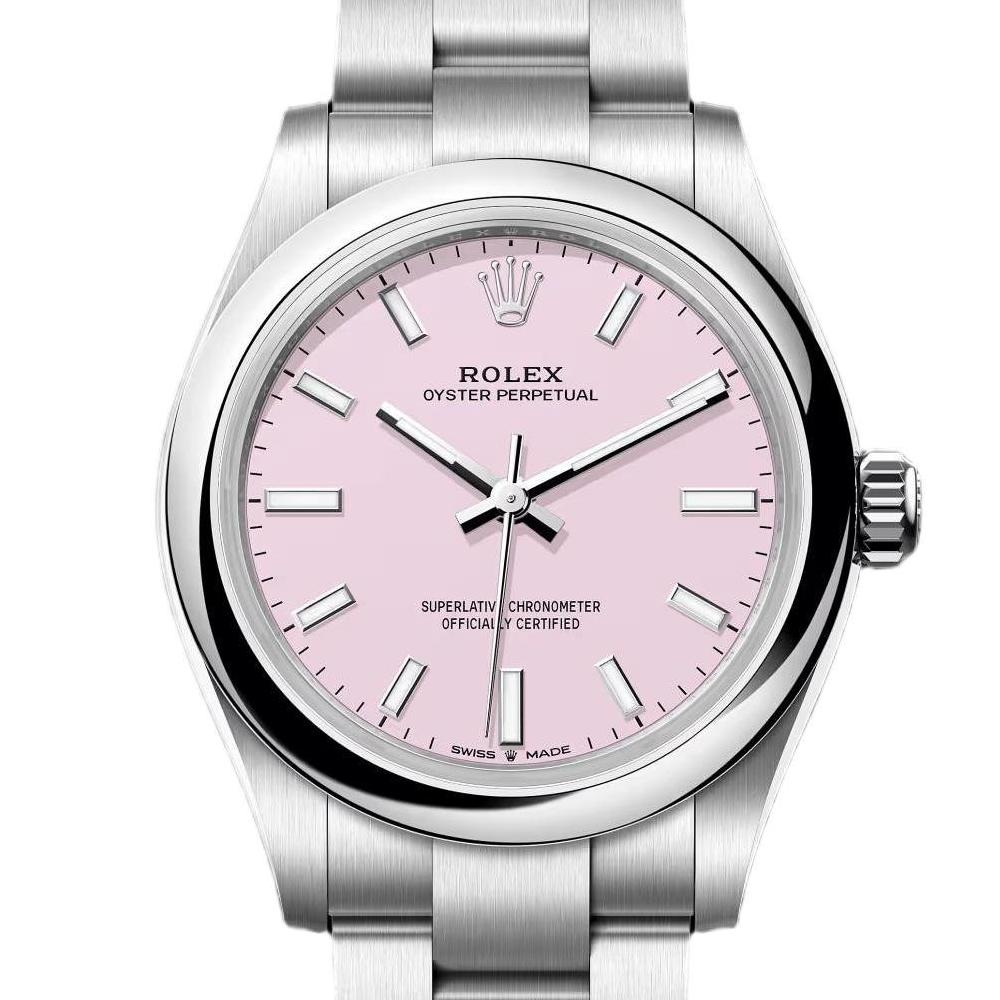
The market response was instantaneous and explosive. Models like the Turquoise Blue and the Green dial quickly traded at multiples of their retail price on the secondary market. The 41mm option (Reference 124300) also joined the lineup, catering to the modern preference for larger wrist presence while maintaining the slim profile characteristic of the time-only models.
Technical Upgrades
Beneath the colorful dials lay significant technical improvements. The new generation was powered by the Caliber 3230 movement. This new caliber boasted Rolex’s Chronergy escapement for improved efficiency, a longer power reserve of approximately 70 hours (up from 48), and enhanced resistance to magnetic fields. It represented the culmination of decades of R&D, ensuring that the Oyster Perpetual was not just a stylistic icon but a technical powerhouse.
Collecting the Oyster Perpetual: What to Look For
For those looking to add an Oyster Perpetual to their collection, whether vintage or modern, there are several key factors to consider.
Condition and Originality
In the vintage market, originality is king. Collectors seek watches with unpolished cases that retain their sharp lug edges, original dials without refinished paint, and matching serial numbers between the case and movement. A “frankenwatch” (a watch assembled from non-original parts) may look correct to the untrained eye but holds little value to a serious collector. Service history is also crucial; a well-maintained vintage Oyster Perpetual can last another lifetime.
Rare References and Dial Variations
Certain references command higher premiums. The Reference 1002 with a “Red Depth Rating” text on the dial is a sought-after variant. Similarly, the aforementioned “Stella” dials from the 1970s are grail pieces for many. In the modern era, the first year of production for the new colorful dials (2020) carries a certain cachet, though availability remains the primary hurdle rather than rarity per se.
The Investment Perspective
Historically, the Oyster Perpetual has shown steady appreciation, particularly for well-preserved vintage examples. While they may not see the meteoric spikes of a Daytona or a GMT-Master II “Pepsi,” they offer a stable entry point into the Rolex market. The 2020 color renaissance has further cemented their status as collectible assets, proving that even the simplest watches can capture the imagination of the market.
Why the Oyster Perpetual Remains Relevant
In a world obsessed with smartwatches, connected devices, and complex complications, the Rolex Oyster Perpetual stands as a testament to the enduring power of simplicity. It does one thing, and it does it better than almost anything else: it tells time reliably, elegantly, and indefinitely.
Its relevance lies in its versatility. It is equally at home on the wrist of a CEO in a boardroom, a diver on a boat (thanks to the Oyster case), or a creative professional making a style statement with a candy-pink dial. It transcends trends because it essentially set them. Every time you look at an Oyster Perpetual, you are looking at the DNA of the modern sports watch.
Conclusion: A Timeless Legacy
The history of the Rolex Oyster Perpetual is more than just a timeline of reference numbers and caliber updates; it is a chronicle of human ingenuity and the pursuit of perfection. From Hans Wilsdorf’s initial vision of a waterproof wristwatch to the vibrant, high-tech marvels of today, the Oyster Perpetual has never wavered from its core mission.
For the collector, owning an Oyster Perpetual is owning a piece of horological history. It is a connection to the past, a reliable companion for the present, and a sound investment for the future. Whether you choose a weathered 1950s Bubbleback, a crisp 1970s Ref. 1500, or a blazing turquoise 2023 model, you are participating in a legacy that has stood the test of time. As the name suggests, it is truly perpetual—a watch designed not just for a lifetime, but for generations.
In the ever-evolving landscape of luxury watches, the Oyster Perpetual remains the constant, the benchmark, and the heart of Rolex. It is a reminder that sometimes, the most profound statements are made in silence, with a simple tick-tock that echoes through the ages.
Frequently Asked Questions (FAQ)
What is the difference between the Rolex Oyster and the Oyster Perpetual?
The “Oyster” refers specifically to the waterproof case technology introduced in 1926. The “Perpetual” refers to the self-winding movement introduced in 1931. The “Oyster Perpetual” is the model name given to watches that combine both features. Historically, some early Oyster watches were manually wound, but today, all Oyster Perpetual models are self-winding.
Is the Rolex Oyster Perpetual a good investment?
Generally, yes. While not as volatile or high-yielding as professional models like the Daytona or GMT-Master II, the Oyster Perpetual has shown consistent value retention and appreciation, especially for vintage models in excellent condition and the new colorful dial versions released in 2020. It is considered a stable entry point into Rolex collecting.
What size Rolex Oyster Perpetual should I buy?
Rolex currently offers the Oyster Perpetual in 28mm, 31mm, 36mm, and 41mm. The 36mm is considered the classic, historical size for men and fits most wrists well. The 41mm is ideal for those who prefer a modern, larger presence. The 28mm and 31mm are popular choices for women or those with smaller wrists who prefer a vintage aesthetic. Ultimately, the best size is the one that feels most comfortable on your wrist.
Are vintage Rolex Oyster Perpetual watches waterproof?
While vintage Oyster Perpetuals were designed to be waterproof, gaskets and seals degrade over time. It is strongly recommended not to submerge a vintage watch unless it has been recently pressure-tested and serviced by a qualified watchmaker. Even then, many collectors choose to keep vintage pieces away from water to preserve their condition.
Leave a Reply