
With the surge of high-quality super clones saturating the luxury watch market, distinguishing a genuine Rolex from a counterfeit has never been more critical. Authentic Rolex timepieces embody precision engineering, timeless craftsmanship, and long-term value—while fakes consistently fall short of the brand’s uncompromising standards. This comprehensive guide breaks down the key hallmarks, hands-on checks, and expert insights to help you verify authenticity with confidence, whether purchasing pre-owned, evaluating your collection, or safeguarding against costly mistakes.
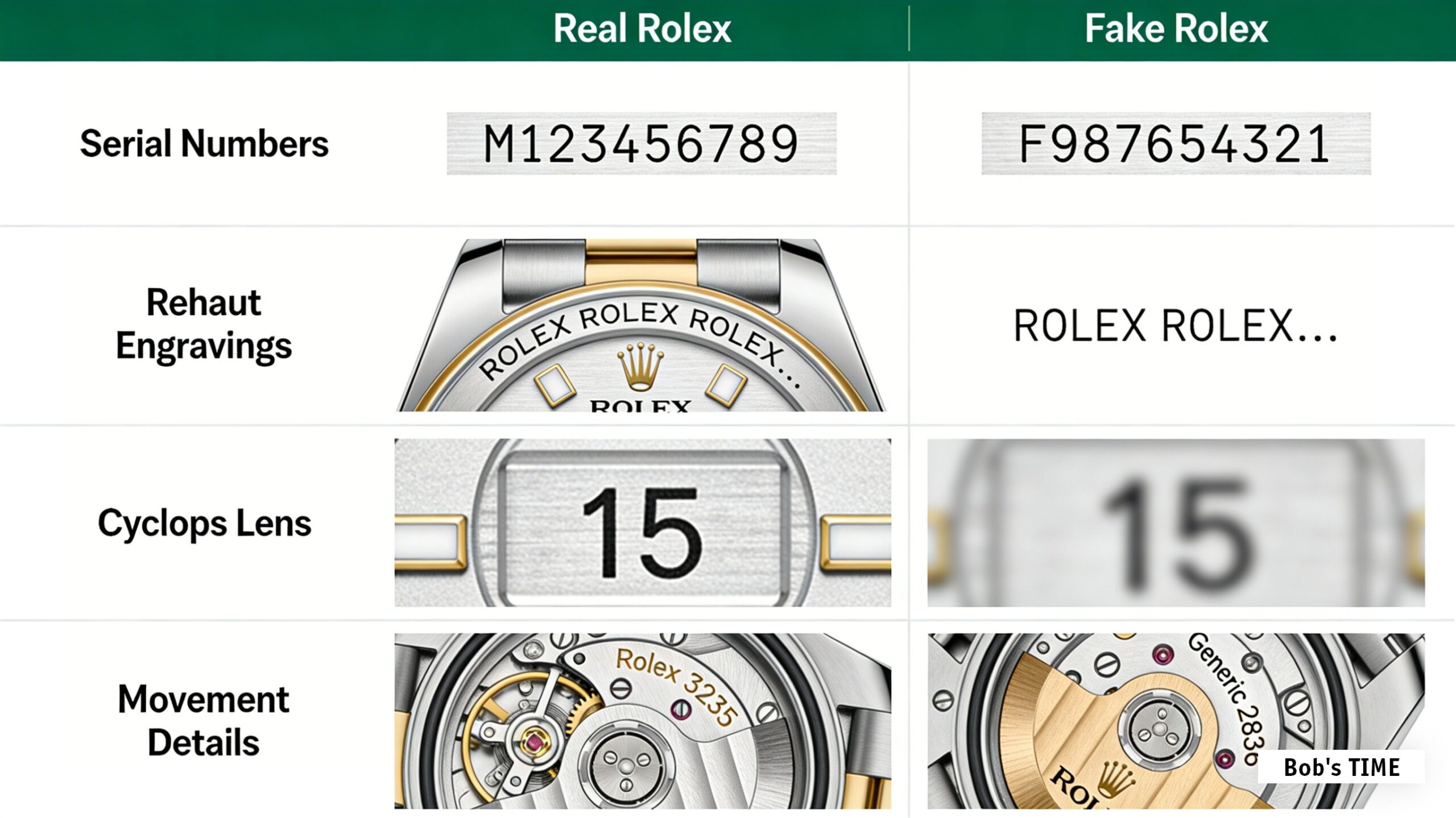
Key Authentication Features: Spot a Real Rolex in Minutes
Genuine Rolex watches are defined by meticulous attention to detail—from proprietary materials to precision engravings. Here’s how to identify these non-negotiable traits:
1. Serial & Reference Numbers: The Watch’s “DNA”
Every authentic Rolex bears unique serial and reference numbers that confirm its identity and production lineage:
- Location by Era:
- Pre-2005: Engraved between the lugs at the 6 o’clock position (bracelet removal required).
- 2005–2008: Present on both the lugs and the rehaut (inner bezel ring).
- Post-2008: Laser-etched exclusively on the rehaut at the 6 o’clock mark.
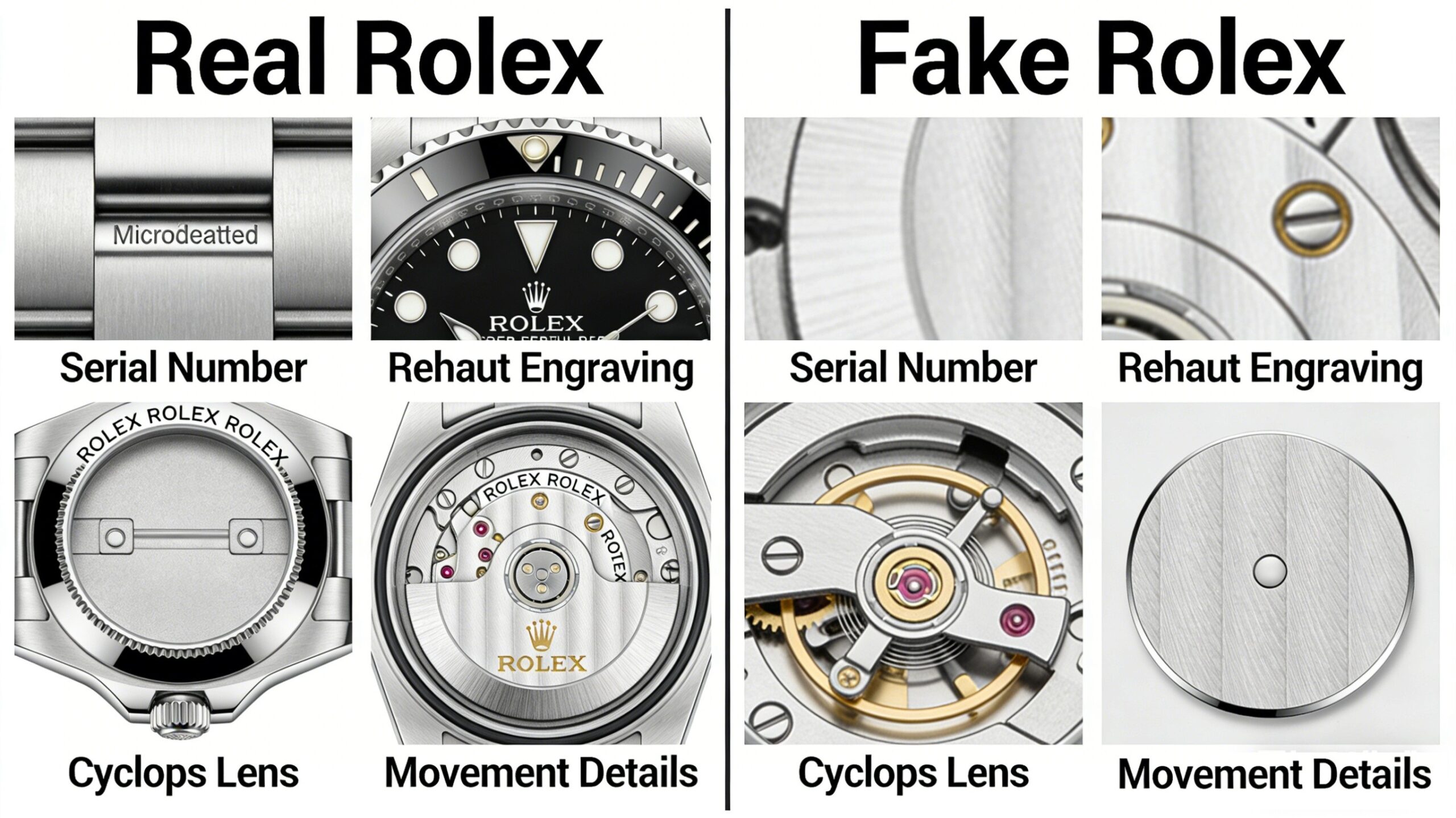
- Engraving Quality: Genuine numbers are deep, crisp, and uniform under 10x magnification—free of blurring, shallow lines, or misaligned fonts. Fakes often feature uneven, “sandy” etchings or filler material.
- Cross-Reference: Match the serial number to Rolex production charts (e.g., “G” denotes 2010, “M” denotes 2014) to ensure the watch’s age aligns with its appearance. Repeated or mismatched numbers are an immediate red flag.
2. Rehaut Engravings & Crystal Micro-Etching
Rolex integrated these anti-counterfeit features into modern models for enhanced security:
- Rehaut Details: Post-2000s models feature a repeating “ROLEX” engraving around the inner bezel, with trilingual variations (English/French/German) on select designs. Genuine engravings are thin, evenly spaced, and sharp—fakes exhibit thick, wobbly letters or inconsistent spacing.
- Laser-Etched Crown (LEC): Since 2002, a tiny (0.1mm) crown logo has been etched at the 6 o’clock position on the sapphire crystal. Visible only with a loupe, it consists of precise dotwork—fakes either exaggerate its size, blur its edges, or omit it entirely.
3. Cyclops Lens & Date Magnification
The iconic Cyclops lens over the date window is a Rolex signature—here’s how to validate its authenticity:
- Magnification: Genuine lenses magnify the date exactly 2.5x, with no distortion, bubbles, or color tint. The date appears flat, centered, and crystal-clear.
- Fake Shortcomings: Counterfeits often magnify at 2x or less, shift the date off-center, or display green tinges from shoddy coating. Test in natural light to spot inconsistencies.
Note: Models without a date (e.g., certain Explorer or Oyster Perpetual variants) do not include a Cyclops lens—this is standard, not a red flag.
4. Dial, Hands, & Lume: Precision Finishing
A genuine Rolex dial reflects Swiss craftsmanship at its peak:
- Print & Logos: “OYSTER PERPETUAL,” model names, and the crown logo at 12 o’clock boast sharp edges, uniform kerning (letter spacing), and no smudges. The crown logo is symmetrical, with evenly spaced branches—fakes feature uneven arms or blurry contours.
- Hands: Sword-shaped seconds hands sweep smoothly (no quartz “tick”) and align perfectly with hour markers. Genuine hands have polished sides and crisp tips—fakes are often dull or misshapen.
- Lume: Post-2008 models use Chromalight lume, which glows evenly blue in low light. Older models feature green lume—both fill markers uniformly without spillover. Fakes fade unevenly or have lumpy application.
5. Movement & Performance: The “Heartbeat” of Authenticity
Rolex’s in-house automatic movements set the benchmark for precision—here’s what to look for:
- Sweep vs. Tick: Genuine movements (e.g., Caliber 3135, 3235) deliver a smooth, silent sweep of the seconds hand. A loud, jerky “tick” indicates a quartz fake (except for the discontinued Oysterquartz series).
- Accuracy: Authentic Rolexes are certified Superlative Chronometers, with a daily deviation of -2/+2 seconds. Fakes typically deviate by 10+ seconds per day.
- Power Reserve: Modern calibers offer 70+ hours of power reserve—fakes usually have shorter reserves (40–50 hours) due to inferior components.
Note: Avoid opening the caseback yourself—this can damage the watch. For movement verification, use a timegrapher or consult a professional.
6. Case, Bracelet, & Materials
Rolex uses proprietary materials and construction that fakes struggle to replicate:
| Feature | Genuine Rolex | Common Fakes |
|---|---|---|
| Weight | Substantial (e.g., Submariner ~155g) due to 904L Oystersteel or precious metals | Lightweight, hollow links, or “filled” with cheap materials (e.g., copper) |
| Finish | Mirror-polished edges, brushed sides—no scratches or unevenness | Rough edges, sloppy polishing, or mismatched finish (e.g., brushed where polished) |
| Crown | Screw-down Triplock/Twinlock with a crisp, raised crown logo; ~1.5 Nm torque to lock | Loose threading, no seal indicators, or a blurry logo |
| Caseback | Solid metal (no engravings) except for rare vintage models | Transparent (to showcase a fake movement) or decorated with logos/engravings |
| Bracelet | Oyster (3-link), Jubilee (5-link), or President (semi-circular) with solid endlinks; articulates smoothly | Hollow, floppy links; poor clasp engravings; stiff or uneven movement |
| Bezel | Rotates with 120 firm clicks (on GMT/Submariner); ceramic inserts have vibrant, wear-resistant color | Loose, wobbly, or grinding rotation; faded or misaligned bezel markings |
7. Documentation & Packaging
Authentic Rolexes come with verified paperwork that aligns with the watch’s details:
- Warranty Card: Post-2007 models use plastic cards with microchips/NFTs (2020+). Pre-2007 cards feature green UV-reactive stickers. Serial numbers on the card must match the watch.
- Box & Papers: The box, manual, and service records (if available) should correspond to the watch’s era. Missing papers don’t invalidate the watch—but they reduce resale value by 10–20%.
- Service History: Genuine records from Rolex Service Centers include authentication reports and part replacements.
Hands-On Authentication Checklist
Follow these steps for a quick, at-home verification:
- Inspect serial/reference numbers under magnification for crisp engravings.
- Check the rehaut (post-2008) for uniform “ROLEX” engravings and the serial number at 6 o’clock.
- Use a loupe to locate the laser-etched crown on the crystal (post-2002).
- Test the Cyclops lens: Confirm 2.5x magnification and a centered date.
- Listen for a smooth sweep (no ticking) and feel the substantial weight.
- Rotate the bezel (if applicable) to ensure firm, precise clicks.
- Screw down the crown—genuines require ~5 turns and feel smooth, not sticky.
- Verify paperwork: Serial numbers must match across the watch, warranty card, and box.
Frequently Asked Questions (FAQs)
Q: Can Rolex serial numbers be faked?
A: Yes, but counterfeiters struggle to replicate the deep, precise laser engraving of genuine Rolexes. Always cross-reference serial numbers with production charts and consult a professional if in doubt.
Q: Is a watch with a transparent caseback fake?
A: Almost certainly. Except for rare vintage models or limited editions (e.g., some Cellini variants), Rolex does not use transparent casebacks on standard production watches. Fakes use them to showcase cheap movements.
Q: Can I authenticate a Rolex without papers?
A: Yes. While papers add credibility, a watch can be authenticated via serial numbers, movement quality, and material checks. Professional horologists can verify authenticity even without paperwork.
Q: How accurate are high-quality super clones?
A: 2026 super clones mimic appearance and weight but fail on key details: shallow rehaut engravings, incorrect lume color, and inferior movement accuracy. Experts can spot them with magnification or timegrapher tests.
Q: When should I get professional authentication?
A: For high-value purchases (e.g., pre-owned Daytonas, Submariners) or if you’re unsure about any detail. Rolex Service Centers or certified horologists (AWCI, GIA) offer reports for $150–$500, with a 3–10 day turnaround.
Q: Are hologram stickers a reliable authenticity check?
A: No. Rolex discontinued hologram stickers in 2002—they are not a valid verification tool for modern watches.
Common Myths Debunked
- Myth: “All real Rolexes have a hologram sticker.” Fact: Stickers were phased out in 2002—ignore them.
- Myth: “Rolex needs servicing every 5 years.” Fact: Rolex recommends full servicing every 10 years (7 years in warm, humid climates) with proper care.
- Myth: “Retail stores authenticate watches for free.” Fact: Only Rolex Service Centers provide official authentication—retailers may offer informal checks but no guarantees.
- Myth: “Fakes are easy to spot.” Fact: 2026 super clones are highly realistic, but they still fail on engravings, movement quality, and material consistency.
Final Tips: Avoid Counterfeits
- Buy from authorized dealers (e.g., Rolex.com, luxury jewelers) or trusted pre-owned platforms (e.g., Chrono24, Bob’s Time) with authentication guarantees.
- Beware of listings priced 30% or more below market value—genuine hot models like the Daytona Panda and Submariner almost always sell at a premium.
- For vintage watches, verify part authenticity (e.g., original dial, hands) with a specialist—replaced parts reduce value and authenticity.
- Invest in a loupe (10x magnification) and timegrapher (for movement accuracy) for at-home checks.
When to Trust a Professional
For high-value watches or if you’re unsure about any detail, consult a Rolex Service Center or certified horologist. They use advanced tools (X-rays, spectral analysis) to detect fake materials, cloned movements, and hidden flaws that are invisible to the naked eye.
By mastering these authentication techniques, you can confidently distinguish a genuine Rolex from a counterfeit—protecting your investment and ensuring you own a timepiece that will last for generations. Remember: Rolex’s reputation for precision extends to every detail—fakes may look the part, but they never match the brand’s uncompromising standards.
Leave a Reply