
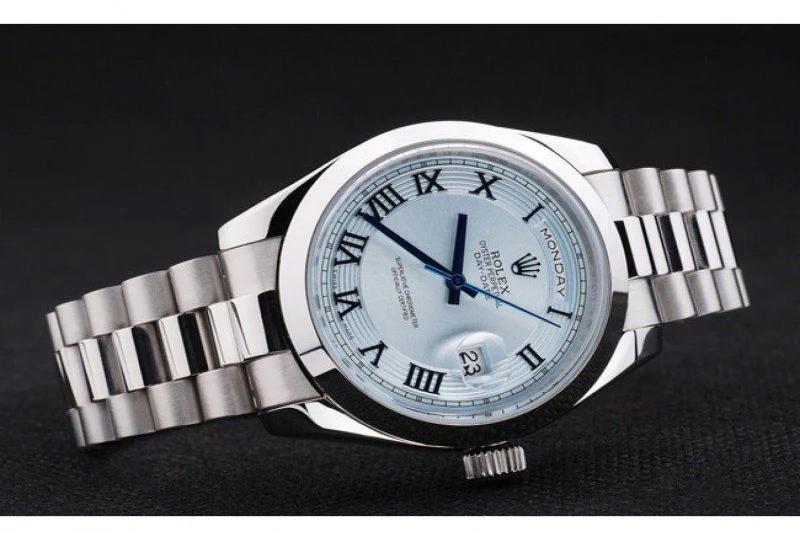
The Rolex Day-Date—affectionately known as the “President’s Watch”—stands as Rolex’s flagship dress watch, a symbol of timeless luxury, meticulous Swiss craftsmanship, and horological innovation since its 1956 debut. Crafted exclusively from precious metals and featuring the iconic full-day and date display (a world first for automatic wristwatches), it’s a coveted piece for serious collectors and luxury enthusiasts alike. While the genuine Day-Date remains the ultimate investment, high-quality Rolex Day-Date super clone and replica options have emerged for those seeking the model’s iconic aesthetic at a more accessible price point. This comprehensive FAQ answers all key questions about the genuine Rolex Day-Date—covering specs, pricing, sizing, maintenance, and value—with brief insights into replica alternatives for context.
Core Questions About the Genuine Rolex Day-Date
What makes the Rolex Day-Date unique among all Rolex models?
Introduced in 1956, the Day-Date is celebrated as the first automatic wristwatch to display the full, unabbreviated day of the week (in multiple languages) alongside the date—its defining technical and design feature. Unlike every other Rolex collection, it is exclusively crafted from precious metals (18k yellow gold, white gold, Everose gold, and 950 platinum) with no stainless steel variants. Paired with the signature President bracelet (a three-piece semicircular link design with a concealed Crownclasp), it earned the “President’s Watch” nickname for its association with global leaders and luxury connoisseurs. Its fluted bezel, 2.5x Cyclops lens over the date, and timeless proportions further solidify its status as Rolex’s most refined dress watch.
What case sizes are available for the genuine Rolex Day-Date?
The modern genuine Day-Date collection is offered in two classic, engineered-for-comfort sizes, with a discontinued larger variant that has become a collector’s rarity:
- 36mm (Day-Date 36): The original and most enduring size, beloved for its balanced proportions (12mm thickness, 44mm lug-to-lug) and versatility—ideal for formal wear and everyday elegance on smaller to medium wrists.
- 40mm (Day-Date 40): Introduced in 2015, it features modernized proportions (12.5mm thickness, 47.5mm lug-to-lug) for a bolder wrist presence, while retaining the Day-Date’s iconic design language for those who prefer a contemporary take.
- 41mm (Day-Date II): Produced only from 2008–2015, this limited-run size has a cult following among collectors for its unique broader bezel and thicker case—powered by the Caliber 3156, it’s a rare find in the pre-owned market.
All genuine models share a 20mm lug width, ensuring consistent bracelet sizing and fit across the collection. For those considering a replica version, top super clone makers mirror these exact dimensions for authentic wrist presence.
What materials and movements define the genuine Rolex Day-Date?
The genuine Day-Date is a masterclass in luxury materials and in-house Rolex engineering:
- Materials: Exclusively 18k yellow/white/Everose gold (Rolex’s proprietary rose gold) or 950 platinum—platinum models feature a signature icy blue dial, a Rolex exclusive for this noble metal. Bezels are solid precious metal (fluted as standard, with gem-set/smooth variations available), and the crystal is scratch-resistant sapphire with a 2.5x Cyclops lens for the date window.
- Movements: Modern 36mm/40mm models use Rolex’s Caliber 3255—an automatic Superlative Chronometer with a 70-hour power reserve, Chronergy escapement, and unrivaled accuracy of -2/+2 seconds per day. Earlier generations use the Caliber 3155/3055, all chronometer-rated for precision. Every movement is designed, manufactured, and assembled in-house by Rolex.
Budget replica Day-Dates often use low-grade alloys and quartz movements, while top super clone versions attempt to mimic the Caliber 3255 with cloned automatic movements and 904L steel with gold plating—though they never match the genuine’s precision or material quality.
What water resistance and bracelet options does the genuine Day-Date offer?
True to Rolex’s “tool watch luxury” philosophy, the genuine Day-Date delivers 100 meters (330 feet) of water resistance, thanks to its Oyster case construction (monobloc middle case, screw-down case back) and Twinlock crown system with two sealed zones. This makes it suitable for daily activities, including shallow swimming—Rolex recommends annual water resistance testing to preserve gasket integrity.
The Day-Date is paired with luxury bracelet/strap options tailored to its dress watch identity:
- President Bracelet: The definitive option, a 3-piece semicircular link design with a concealed Crownclasp for a seamless, elegant finish.
- Oyster Bracelet: A rare sportier alternative, found mostly on platinum models with 3-piece flat links.
- Pearlmaster Bracelet: Reserved for gem-set Day-Date models, with rounded 5-piece links to complement diamond detailing.
- Custom Leather Straps: Available via Rolex for a classic, understated dress aesthetic.
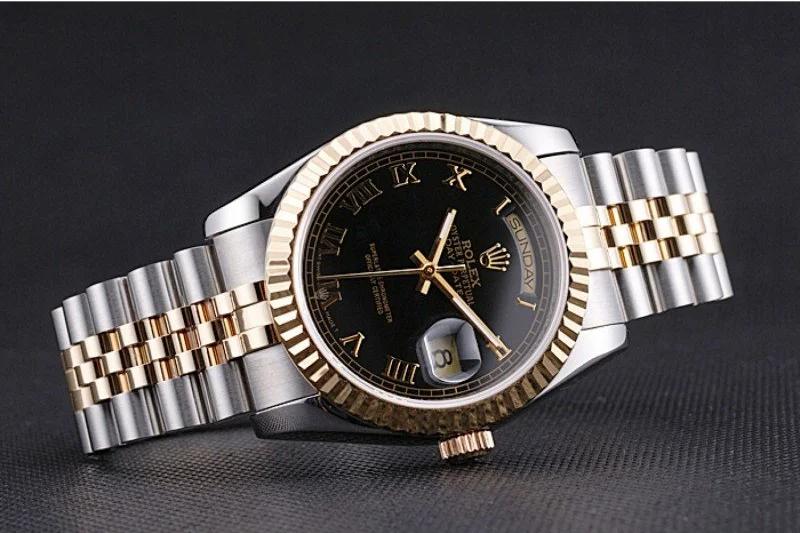
Vintage genuine Day-Dates may feature the Jubilee bracelet (a rare special order), a highly sought-after detail for collectors—some super clone models replicate this rare bracelet for added realism.
Buying & Pricing FAQs (Genuine Day-Date Focus)
How much does a genuine Rolex Day-Date cost in 2026?
Pricing for the genuine Day-Date varies significantly based on case size, precious metal, condition (vintage/modern), and rarity, with no entry-level stainless steel options:
- Vintage gold models (e.g., Ref 1803): The most accessible genuine Day-Dates, with pre-owned prices starting in the high $8,000–low $10,000 range for well-preserved pieces.
- Modern 36mm/40mm gold models (e.g., Ref 128238, 228235): New retail prices start at over $30,000, with pre-owned prices holding steady at 80–90% of retail for mint condition.
- Platinum models (icy blue dial): The most exclusive Day-Dates, with new retail prices exceeding $50,000 and pre-owned prices remaining highly stable due to limited production.
- Rare variants (gem-set, Day-Date II): Collectible models command premium prices, with gem-set Day-Dates reaching six figures and Day-Date II pieces selling for $15,000+ pre-owned.
In contrast, Rolex Day-Date replica and super clone options range from under $200 (budget fakes) to under $1,000 (high-quality clones)—a fraction of the genuine cost, but with no resale value or horological merit.
Do genuine Rolex Day-Date watches hold their value—and are they a good investment?
Absolutely—the genuine Day-Date is one of the most stable luxury watch investments on the market, with far less price volatility than Rolex’s stainless steel sports models (e.g., Submariner, Daytona). Its exclusive precious metal construction, consistent collector demand, and limited production ensure steady long-term appreciation:
- Platinum models are the most stable, with minimal price swings and fast recoveries during market shifts.
- Vintage and neo-vintage gold models (e.g., Ref 18038) have seen consistent annual appreciation, with well-preserved pieces doubling in value over the past decade.
- Rare variants (gem-set dials, Day-Date II) and specialty editions (e.g., puzzle dials) often appreciate immediately after purchase for serious collectors.
Even after the 2021 luxury watch market correction, genuine Day-Date prices remain well above pre-2020 levels—making it a sound investment for those seeking a luxury timepiece that retains value while delivering timeless wearability. Super clone and replica versions hold no monetary value and are not investments—they are for aesthetic use only.
What should I look for when buying a pre-owned genuine Rolex Day-Date?
For pre-owned genuine Day-Dates, authenticity and condition are everything—always buy from a trusted, reputable seller with rigorous authentication processes. Key checks include:
- Serial/Reference Numbers: Crisp, laser-etched numbers (between the lugs or on the rehaut) that match the model’s production era—no blurring, shallow engraving, or mismatched numbers (a red flag for fakes).
- Complete Documentation: Original warranty card, box, and service records—papers boost the watch’s value by 10–20% and confirm provenance. Post-2007 warranty cards feature microchips/NFTs for digital verification.
- Original Parts: Ensure the case, bracelet, movement, and dial are all genuine Rolex—aftermarket parts devalue the watch significantly.
- Condition: Minimal polishing (excessive polishing removes metal and devalues vintage pieces), smooth crown/winder operation, and accurate timekeeping. A recent Rolex service (with paperwork) is a major plus.
- Water Resistance: A recent pressure test to confirm gasket integrity—critical for preserving the watch’s performance.
Professional authentication from a certified horologist or Rolex Service Center is recommended for high-value pre-owned purchases—this is the only way to guarantee you’re not buying a high-quality super clone passed off as genuine.
Should I buy a new or pre-owned genuine Day-Date?
Both options offer distinct advantages, depending on your goals:
- New: Guarantees pristine condition, the latest Caliber 3255 movement, full Rolex factory warranty (5 years), and no prior wear—ideal for those who want a “brand new” luxury piece with complete peace of mind.
- Pre-Owned: Offers significant cost savings (10–30% off retail for mint condition), access to rare/vintage models (e.g., Day-Date II, Ref 1803) that are no longer in production, and the potential for immediate value appreciation for collectible pieces—perfect for seasoned collectors or those seeking a genuine Day-Date at a more accessible price.
For those who cannot afford a genuine Day-Date, high-quality super clone models are a cosmetic alternative—but they lack the genuine’s craftsmanship, material quality, and investment value.
Sizing & Wearability FAQs (Genuine Day-Date)
36mm vs. 40mm Day-Date: Which size is better for me?
The choice between the 36mm and 40mm genuine Day-Date comes down to wrist size and personal style—both are engineered for optimal comfort and wearability, with no “better” option, only preference:
- 36mm: A classic men’s dress watch size (ideal for wrists 6–7 inches), perfect for formal wear and understated luxury. It’s the most timeless Day-Date size, beloved by collectors for its original 1956 proportions and versatility across all occasions.
- 40mm: A modern, bold size (ideal for wrists 7+ inches) with a more prominent wrist presence. It retains the Day-Date’s elegance but adds a contemporary edge, making it suitable for both formal wear and casual luxury—popular with younger enthusiasts and those who prefer larger watch sizes.
The discontinued 41mm Day-Date II is a niche choice for collectors who favor oversized proportions, with limited availability in the pre-owned market. Replica and super clone models mirror both 36mm and 40mm sizes for those seeking the aesthetic of either variant.
Is a 36mm genuine Day-Date too small for men?
No—36mm is a classic, timeless men’s dress watch size and remains one of the most popular Day-Date sizes for male enthusiasts. While larger watch sizes (40mm+) have trended in recent years, the 36mm Day-Date’s balanced proportions (12mm thickness, 44mm lug-to-lug) make it elegant and comfortable on most men’s wrists (6–7 inches). It’s the original Day-Date size, designed for understated luxury—and its timeless appeal means it never goes out of style. For collectors, the 36mm Day-Date is often considered the “authentic” Day-Date experience, with the 40mm serving as a modern evolution. Even super clone makers acknowledge the 36mm’s iconic status, with it being the most popular replica size for the Day-Date.
Can the genuine Rolex Day-Date be worn daily?
Yes—despite its status as a luxury dress watch, the genuine Day-Date is built with Rolex’s legendary durability and is fully suitable for daily wear. Its 100m water resistance, scratch-resistant sapphire crystal, and precious metal construction (resistant to corrosion and wear) make it robust enough for everyday activities—from office wear to shallow swimming. The President bracelet is engineered for all-day comfort, with smooth articulation and a secure clasp, and the watch transitions seamlessly from formal events to casual outings. With basic care, a genuine Day-Date will last for generations—becoming a family heirloom, a hallmark of Rolex’s craftsmanship. In contrast, even high-quality super clone models are not built for lifelong wear, with most lasting 5–10 years with daily use (vs. a century or more for the genuine).
Maintenance & Care FAQs (Genuine Day-Date)
How do you set the day and date on a genuine Rolex Day-Date?
Modern genuine Day-Date models feature double quickset functionality for easy, precise day/date adjustment—always avoid adjusting the day/date between 8 PM and 3 AM, as this can damage the movement’s internal gears during the automatic date change cycle. The steps are:
- Unscrew the Twinlock crown counterclockwise and pull it out to the first position for date adjustment—turn clockwise to cycle through the dates.
- Pull the crown out to the second position for day adjustment—turn counterclockwise to cycle through the full, unabbreviated days of the week (in your chosen language).
- For time adjustment, use the second position and turn the crown clockwise; once set, push the crown back in and screw it down tightly to maintain water resistance.
Older genuine Day-Date models (pre-quickset) require winding the crown to adjust the day/date—a process best done by a Rolex-certified watchmaker to avoid damage. Super clone and replica models may mimic quickset functionality, but the mechanism is often less smooth and precise than the genuine.
What is the recommended maintenance schedule for a genuine Rolex Day-Date?
Rolex recommends a full professional service every 10 years for the genuine Day-Date, with 5-year inspections for active wearers or those in warm/humid climates. Routine at-home care is simple and ensures the watch remains in peak condition for decades:
- Daily: Wipe the watch with a lint-free microfiber cloth to remove sweat, dust, and fingerprints—prevents buildup on the precious metal and crystal.
- Quarterly: Clean the watch with mild, ammonia-free soap and lukewarm water (scrub gently with a soft nylon brush on the bracelet/ case); rinse thoroughly and dry immediately. Never use harsh chemicals or abrasives (toothpaste, baking soda)—they etch precious metals and dull finishes.
- Annually: Have the watch’s water resistance pressure-tested by a Rolex Service Center to preserve gasket integrity.
- Biennially: Demagnetize the watch (magnets from phones/speakers can disrupt movement accuracy) and check timekeeping with a timegrapher.
A full Rolex Service Center overhaul (2026 estimates: $800–$2,800+ based on model) includes ultrasonic cleaning, genuine Rolex part replacements (gaskets, worn components), movement lubrication, waterproof testing, and Superlative Chronometer recertification—critical for preserving the watch’s value and performance. Replica and super clone models cannot be serviced at Rolex Service Centers and require independent watchmakers for basic repairs.
Can I service a genuine Day-Date at any watch repair shop?
For genuine Rolex parts, official warranty coverage, and factory-spec craftsmanship, always service your Day-Date at an authorized Rolex Service Center or a Rolex-certified watchmaker. Independent watchmakers can perform basic maintenance (e.g., battery replacement for quartz fakes—not genuine Day-Dates), but only Rolex Service Centers offer:
- Genuine Rolex replacement parts (gaskets, movements, components).
- Factory-spec polishing and finishing (preserves the watch’s original design and value).
- Official Superlative Chronometer recertification (guarantees the -2/+2 seconds per day accuracy).
- Warranty coverage for all service work (2 years for Rolex overhauls).
Unauthorized service with non-genuine parts devalues the Day-Date significantly and voids any remaining factory warranty—this is a critical mistake for collectors to avoid.
Additional Questions
I. Pricing & Value of the Day-Date
Q: How much is a Day-Date Rolex worth? / How much is a Rolex Day-Date worth? / What’s the price of a Rolex Day-Date?
A: A genuine Rolex Day-Date’s value ranges drastically by metal, size, condition, and rarity in 2026. Pre-owned vintage gold models (e.g., Ref 1803) start at ~$8,500–$10,000, modern 36mm/40mm gold Day-Dates (new) retail at over $30,000 (pre-owned mint condition holds 80–90% of retail), and exclusive platinum icy blue dial models start at $50,000+ new. Rare gem-set or discontinued Day-Date II variants can reach six figures for collectible pieces.
Q: Does a Rolex Day-Date hold value?
A: Yes, the Rolex Day-Date is one of the most value-stable luxury watches on the market, with far less price volatility than Rolex’s stainless steel sports models. Its exclusive precious metal construction, limited production, and consistent collector demand drive steady long-term appreciation. Platinum models are the most stable, vintage/neo-vintage gold pieces have seen annual value growth, and even post-2021 market corrections, Day-Date prices remain well above pre-2020 levels. Well-maintained rare variants often appreciate immediately after purchase.
Q: How much is a Rolex Day-Date just?
A: This is likely a misphrase (intended: How much is a Rolex Day-Date typically?). A genuine Rolex Day-Date has no “entry-level” price point (it is only crafted in precious metals), with the most affordable genuine options being well-worn vintage gold models starting at approximately $8,500–$10,000 in the pre-owned market. High-quality super clone Day-Date replicas cost under $1,500 for cosmetic similarity, with no horological or monetary value.
II. Rolex Options for a $4,000/$5,000 Budget & The Most Affordable Rolex Models
Q: What Rolex can I get for $5000? / Can you get a Rolex for $5000? / Can you get a Rolex for $4000? / Can I get a Rolex for $4000?
A: A genuine, authenticated Rolex is extremely rare for $4,000–$5,000—this budget falls below the market value of even the most well-worn, older Rolex sports models (e.g., vintage Oyster Perpetual, early Submariner). Any “Rolex” offered at this price is almost always a fake, super clone, or a watch with non-genuine parts/serious damage (e.g., broken movement, replaced case/bracelet). For $4,000–$5,000, you may find authentic vintage Rolex parts or pre-owned entry-level luxury watch alternatives (non-Rolex) with genuine craftsmanship.
**Q: What is the best watch to buy for $5000?**
A: For a $5,000 budget, genuine Rolex is not a realistic option, but you can purchase high-quality authentic pre-owned luxury watches from reputable brands with Swiss craftsmanship, including: mid-tier Tudor models (Rolex’s sister brand, e.g., Tudor Black Bay, full stainless steel, automatic movement), pre-owned Omega Seamaster 300 (vintage variants), or Breitling Colt Automatic. These offer genuine Swiss horology, durability, and brand recognition—far better value than a fake/super clone Rolex at the same price. If you prefer the Rolex aesthetic, this budget can also buy a high-end Rolex super clone (e.g., Submariner, Day-Date) with premium materials (904L steel, cloned Swiss movements), for cosmetic wear only.
Q: How much is a cheapest Rolex watch? / Which is the most affordable Rolex?
A: The most affordable genuine Rolex in 2026 is the Rolex Oyster Perpetual 31mm/34mm (stainless steel, no date complication), with a new retail price starting at ~$6,500–$7,000. Pre-owned mint condition variants of this model are the most accessible genuine Rolex, with prices starting at approximately $5,500–$6,000—this is the absolute floor for an authenticated, all-genuine Rolex with no damage or non-genuine parts. All other Rolex collections (Datejust, Submariner, Day-Date) start at a significantly higher price point (>$10,000+ pre-owned).
III. Authenticity of $4,000 Rolex, Charity Myth & Rolex Real vs. Fake Identification
Q: Is a $4k Rolex real?
A: No—a genuine, authenticated Rolex is never available for $4,000 in the legitimate market. This price point is well below the value of even the most worn, oldest genuine Rolex models, and any “Rolex” sold for $4,000 is guaranteed to be a fake, super clone, or a watch with non-genuine parts (e.g., replaced movement, case, or bracelet), or a damaged piece with irreparable issues (e.g., broken chronometer, water damage). Always avoid Rolex listings at this price—they are not authentic.
Q: Is it true that 90% of Rolex profits go to charity?
A: This is a common myth—Rolex’s parent company (Hans Wilsdorf Foundation, a Swiss charitable trust) owns the brand, and while the foundation donates a significant portion of Rolex’s annual profits to Swiss and global charitable causes (e.g., education, environmental conservation, medical research), there is no official confirmation of a 90% donation rate. The foundation does not disclose exact profit donation percentages, but it is widely known that Rolex’s profits fund charitable initiatives (a core part of Hans Wilsdorf’s original vision for the brand), with the remaining profits reinvested into Rolex’s manufacturing, research, and development.
Q: How to tell if a Rolex is real or fake?
A: Authenticating a Rolex requires checking microscopic details and core design/engineering features—high-quality super clones require a loupe (10x+) or professional inspection, but these key checks spot 90% of fakes:
- Serial/Reference Numbers: Genuine Rolex has crisp, laser-etched numbers (between lugs or on the rehaut) with no blurring; fakes have shallow, uneven engravings.
- Cyclops Lens: Genuine has a precise 2.5x magnification (no distortion, centered date); fakes often have 2x or less magnification, with misaligned/foggy lenses.
- Movement & Seconds Hand: Genuine Rolex has a smooth sweeping seconds hand (no quartz “tick”) and in-house automatic movement (Caliber 3135/3235); fakes use cheap quartz or noisy Chinese automatics with a ticking second hand.
- Materials & Weight: Genuine uses 904L Oystersteel (hefty, corrosion-resistant) or precious metals; fakes use lightweight 316L steel/alloy with hollow bracelet links.
- Rehaut & Crystal Micro-Etching: Modern genuine Rolex has a laser-etched repeating “ROLEX” rehaut and a tiny coronet logo at 6 o’clock on the sapphire crystal (only visible with a loupe); fakes omit or botch these details.
- Documentation: Genuine Rolex includes a matching warranty card (microchip/NFT post-2007), box, and service records; fakes have fake or mismatched paperwork.For absolute certainty, have the watch authenticated by a certified horologist or authorized Rolex Service Center—this is the only way to confirm authenticity for high-quality super clones.
IV. Day-Date 36mm vs. 40mm & The Thinnest Rolex Ever Made
Q: Is day-date 36 or 40 better? / Should I get a 36mm or 40mm watch?
A: There is no “better” size— the choice between 36mm and 40mm Day-Date comes down to wrist size and personal style:
- 36mm: A classic men’s dress watch size (ideal for wrists 6–7 inches), perfect for formal wear and understated luxury. It is the original 1956 Day-Date size, beloved by collectors for its timeless proportions and versatility across all occasions.
- 40mm: A modern, bold size (ideal for wrists 7+ inches) with a more prominent wrist presence. It retains the Day-Date’s elegance with a contemporary edge, suitable for both formal and casual luxury—popular with younger enthusiasts who prefer larger watch sizes.If you prioritize timelessness and classic dress watch aesthetics, choose 36mm; if you prefer modern wrist presence and a contemporary look, choose 40mm.
Q: What is the difference between Day-Date 36 and 40?
A: The core design and features (precious metal construction, Caliber 3255 movement, 100m water resistance, President bracelet) are identical for the 36mm and 40mm Day-Date— the only differences are proportions and wrist presence:
- 36mm: 12mm thickness, 44mm lug-to-lug, classic slim profile (original 1956 dimensions) – ideal for smaller/medium wrists, formal wear.
- 40mm: 12.5mm thickness, 47.5mm lug-to-lug, bolder modern profile (introduced 2015) – ideal for medium/large wrists, casual/formal wear with a contemporary edge.Both share a 20mm lug width, the same Superlative Chronometer accuracy (-2/+2 seconds/day), and identical precious metal craftsmanship—no functional differences exist between the two sizes.
Q: Is a Day-Date 40 a good investment?
A: Yes, the Day-Date 40 is an excellent investment—it offers the same value stability and long-term appreciation as the 36mm Day-Date, with the added appeal of modern proportions that attract a growing base of younger collectors. Its precious metal construction (no stainless steel variants), limited production, and Rolex’s iconic design ensure steady value growth; mint condition pre-owned 40mm gold models hold 80–90% of retail value, and platinum 40mm variants are among the most value-stable Rolex models on the market. For collectors seeking a modern Day-Date with investment potential, the 40mm is a top choice.
Q: Is the 36mm day-date too small for men?
A: No—36mm is a classic, timeless men’s dress watch size and remains one of the most popular Day-Date sizes for male enthusiasts. While larger watch sizes (40mm+) have trended in recent years, the 36mm Day-Date’s balanced proportions (12mm thickness, 44mm lug-to-lug) make it elegant and comfortable on most men’s wrists (6–7 inches). It is the original Day-Date size, designed for understated luxury, and its timeless appeal means it never goes out of style—many collectors consider the 36mm the “authentic” Day-Date experience.
Q: Is 40mm too small for men?
A: No—40mm is a standard, universally flattering size for men’s luxury watches (including Rolex) and is not considered “too small” for any male wrist size (7+ inches for the Day-Date 40). It is the most popular modern size for Rolex sports and dress watches, offering a bold wrist presence without being oversized or uncomfortable. For men with larger wrists (8+ inches), the 40mm Day-Date still wears well (its 47.5mm lug-to-lug ensures a secure fit), and it is far from the “too small” category—oversized watch sizes (44mm+) are a niche choice, while 40mm is the mainstream modern standard.
Q: What is the thinnest Rolex ever made?
A: The thinnest Rolex ever produced is the Rolex Cellini Prince (Ref 5441) (introduced in 1928, reissued in modern variants), with an ultra-slim case thickness of just 6.5mm. A close second is the modern Rolex Cellini Classic 39mm (dress watch), with a case thickness of 7.6mm—both are hand-wound dress watches, engineered for slimness and formal wear (in contrast to Rolex’s robust Oyster case sports models, which are thicker for water resistance/durability). Rolex’s Oyster case models (e.g., Submariner, Day-Date) are intentionally thicker (12–13mm) to maintain their iconic tool watch luxury and functional features (e.g., water resistance, automatic movements).
Final Thoughts on the Genuine Rolex Day-Date
The Rolex Day-Date is more than a luxury watch—it’s a piece of horological history, a symbol of uncompromising craftsmanship, and a stable long-term investment. Its exclusive precious metal construction, iconic design, and in-house Rolex engineering make it a standout in the luxury watch market, with a legacy that spans over 65 years. While super clone and replica options offer the Day-Date’s aesthetic at a lower cost, they never replicate the genuine’s precision, material quality, or emotional and investment value. For those who can afford it, a genuine Rolex Day-Date is a timeless addition to any collection—one that can be worn daily, passed down through generations, and enjoyed for a lifetime. For pre-owned or new purchases, always prioritize trust, authenticity, and documentation—your Day-Date deserves nothing less than the care and respect befitting a Rolex flagship.
If you found this guide helpful, feel free to share it with fellow watch lovers!
Leave a Reply